


Business Transformation Requires Transformational Leaders
Leadership and teaming skills are front and center in times of rapid change. Meet today’s constant disruption head on with expert guidance in leadership, business strategy, transformation, and innovation. Whether the disruption du jour is a digitally-driven upending of traditional business models, the pandemic-driven end to business as usual, or the change-driven challenge of staffing that meets your transformation plans — you’ll be prepared with cutting edge techniques and expert knowledge that enable strategic leadership.
Subscribe to Arthur D. Little's Culture & Leadership Newsletter
Insight
Abstract
Change is a fact of life and has many benefits, but it is hardly ever easy and brings huge stress. How you manage the change process can determine not only the ultimate success of the change effort, but also the health of your organization during and after the change.
Change is a fact of life. While change can have many benefits, it is hardly ever easy and often brings huge stress to an organization. Many people fear change and prefer to stay in a situation that feels familiar and comfortable. Since all change also alters the dynamics within an organization, it can evoke anxiety and stress and stir conflict.
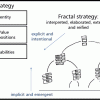

In the accompanying Executive Report, we consider the pressures on organizations to master the art of change and present a fractal metaphor for the tandem role of strategy and architecture. This metaphor derives from Amazon CEO Jeff Bezos's observation that strategy happens fractally at Amazon -- set at different scales throughout the business. Strategy is a mechanism for business leaders to create coherence of purpose and identity among organizational elements and to create cross-organizational synergies.

This month, we have tapped into the expertise and knowledge of two contributors with significant backgrounds in e-learning. On the academic side is Aurelio Ravarini, Senior Assistant Professor of IS at Università Carlo Cattaneo (LIUC, Italy) and Director with LIUC's CETIC, Research Center on Information Systems. Many of you will recall Aurelio as a past contributor to CBR; he was our academic expert on the issues on content management systems (Vol. 6, No. 4) and software as a service (Vol. 9, No. 4 ). Our practitioner author is Gianni Maria Strada, a former HR executive of several US corporations and current Managing Partner of PeoplePoint, a boutique HR consulting firm focused on major organizational change processes. Both contributors have considerable experience with the organizational implementation of software applications and their consequential organizational change processes.
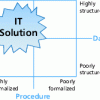
It was more than half a century ago when scholars in management science began speculating about the role of information technology in organizations. Back in the late 1950s, Harold J. Leavitt and Thomas L. Whisler envisioned the organizational impacts of IT, including its implications on the design of organizations with their seminal article in Harvard Business Review.1
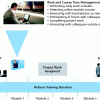
A New Renaissance for Job Development
Fifteen years of technological development has paved the way toward more flexible and virtual organizations. Many activities and processes have been delocalized, both on the individual and enterprise levels. IT -- and all its advancements -- has allowed employees to choose not only where their jobs can be performed but also when to undertake their daily activities. Even with traditional fixed due dates for each activity, work has become bound by nearly no time frame.
This month, we have tapped into the expertise and knowledge of two contributors with significant backgrounds in e-learning.