


Business Transformation Requires Transformational Leaders
Leadership and teaming skills are front and center in times of rapid change. Meet today’s constant disruption head on with expert guidance in leadership, business strategy, transformation, and innovation. Whether the disruption du jour is a digitally-driven upending of traditional business models, the pandemic-driven end to business as usual, or the change-driven challenge of staffing that meets your transformation plans — you’ll be prepared with cutting edge techniques and expert knowledge that enable strategic leadership.
Subscribe to Arthur D. Little's Culture & Leadership Newsletter
Insight
This month, we have tapped into the expertise and knowledge of two contributors with significant backgrounds in e-learning. On the academic side is Aurelio Ravarini, Senior Assistant Professor of IS at Università Carlo Cattaneo (LIUC, Italy) and Director with LIUC's CETIC, Research Center on Information Systems. Many of you will recall Aurelio as a past contributor to CBR; he was our academic expert on the issues on content management systems (Vol. 6, No. 4) and software as a service (Vol. 9, No. 4 ). Our practitioner author is Gianni Maria Strada, a former HR executive of several US corporations and current Managing Partner of PeoplePoint, a boutique HR consulting firm focused on major organizational change processes. Both contributors have considerable experience with the organizational implementation of software applications and their consequential organizational change processes.
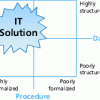
It was more than half a century ago when scholars in management science began speculating about the role of information technology in organizations. Back in the late 1950s, Harold J. Leavitt and Thomas L. Whisler envisioned the organizational impacts of IT, including its implications on the design of organizations with their seminal article in Harvard Business Review.1
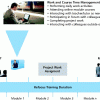
A New Renaissance for Job Development
Fifteen years of technological development has paved the way toward more flexible and virtual organizations. Many activities and processes have been delocalized, both on the individual and enterprise levels. IT -- and all its advancements -- has allowed employees to choose not only where their jobs can be performed but also when to undertake their daily activities. Even with traditional fixed due dates for each activity, work has become bound by nearly no time frame.


To increase profits by increasing revenues, you have to be successful in making a particular case to your customers. You must convincingly present them with a value proposition that says: "Buy mine -- it costs more, but it's better."


I have experienced and witnessed an explosion in system design problems that are the byproduct of missing or incompetent systems analysts. Whether the development approach taken by a company is agile or traditional, the success or failure of the system is determined by the effectiveness of the analysis and design activities.


While the iPad continues to sell briskly, bloggers, pundits, poets, everyday people, and competitors wax on, admirably, jealously, and, once in a while, eloquently. More than probably any other device, this one found a truck-sized hole where none was seen. Standing in the no man's land between the cell phone and the laptop, it found this so-called desert fertile enough.


I recently bought a new car. It's a Volkswagen Jetta, and it was made in Mexico. Not all of it -- most of it. Many of the parts were made in Germany, China, Hungary, the US, and several other countries. It's getting increasingly difficult these days to nail down the country of origin when you buy a new car.