


Business Transformation Requires Transformational Leaders
Leadership and teaming skills are front and center in times of rapid change. Meet today’s constant disruption head on with expert guidance in leadership, business strategy, transformation, and innovation. Whether the disruption du jour is a digitally-driven upending of traditional business models, the pandemic-driven end to business as usual, or the change-driven challenge of staffing that meets your transformation plans — you’ll be prepared with cutting edge techniques and expert knowledge that enable strategic leadership.
Subscribe to Arthur D. Little's Culture & Leadership Newsletter
Insight

The shift in power from the CIO/CTO to the CFO for technology project justification is a fact of life that all of us in the technology industry are familiar with. We no longer have to sell the techies on the value of new IT projects, we have to sell to the financial part of the organization: the business.


This installment of CBR focuses on an often-neglected issue: reverse logistics. To help us better understand the potential of the reverse logistics process, and keeping with our standard process, we recruited both an academic and a practicing professional. Our academic on this issue is a returning contributor, Kathryn Brohman, Assistant Professor of Management Information Systems at the School of Business at Queen's University in Kingston, Ontario (Canada). Kathryn and I share an interest in customer service systems and IT-enabled service.
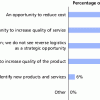

This survey examined how organizations are using IT to better manage their reverse logistics process and whether opportunities exist to leverage an improved reverse logistics process to reduce costs, develop better relationships with customers, and capture knowledge that may be critical to the development of new products and services.




Agility is not reaching far enough into organizations. Too many agile development initiatives fall far short of their potential. Too many organizations have a few successful agile projects, but fail to sustain agility. Success on a few, or even more than a few, projects doesn't translate to wider acceptance of agile principles and practices in the organization.