


Business Transformation Requires Transformational Leaders
Leadership and teaming skills are front and center in times of rapid change. Meet today’s constant disruption head on with expert guidance in leadership, business strategy, transformation, and innovation. Whether the disruption du jour is a digitally-driven upending of traditional business models, the pandemic-driven end to business as usual, or the change-driven challenge of staffing that meets your transformation plans — you’ll be prepared with cutting edge techniques and expert knowledge that enable strategic leadership.
Subscribe to Arthur D. Little's Culture & Leadership Newsletter
Insight
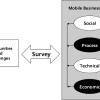
Mobile technologies create opportunities for an enterprise to be flexible and dynamic in an agile business world.1 These opportunities are primarily resulting from a creative and strategic application of information and communications technologies (ICT). The role of ICT in business has gone beyond merely providing data and information to businesses and has become a core business initiator that few could have imagined.

Last month's installment of CBR took us into unchartered territory. This month we get back to what we do best: we evaluate an emerging or evolving trend and benchmark it through a survey of our readership. The focus in this issue is the mobile platform. Mobile technology, its applications, and the services that are delivered over the wireless channel continue to evolve.


SURVEY DEMOGRAPHICS


The waves of the business cycle are becoming ripples. The recent American combination of minimal inflation and very low unemployment may not be an aberration, but the beginning of a new worldwide trend. Smarter government policy, globalization, changes in employment, advances in information technology, and emerging markets all cushion shocks and dampen the familiar boom and bust.


We all feel the pressure from today's economic climate. Business strategy has shifted to a straightforward focus: survive the current downturn. Interestingly, this coincides with the 150th anniversary of the publication of Darwin's The Origin of Species.

A CAUTIONARY TALE: HOW NOT TO CUT IT COSTS IN A DOWNTURN
Years ago I worked as a product line manager, responsible for development of six products, in the IT organization of a US $17 billion public firm. Immediately following senior corporate and IT leadership changes, we implemented an aggressive cost-cutting program using the (ill-advised) tactics I will describe in this article.


Different people have diverse beliefs as to what a successful contract is. Some would consider a contract successful if it did not end up in court. Others believe it to be successful if they did not need to manage the contractor too much. In a recession, it will be about getting it cheaper than before.


Portfolios are widely accepted and used by IT organizations to help manage sets of related IT assets, activities, and resources. These include projects, applications, infrastructure components, and IT services. The goals and intentions of using portfolios as management tools are all related to improving the business value delivered or derived from IT assets and capabilities by: