Strategic advice to leverage new technologies
Technology is at the heart of nearly every enterprise, enabling new business models and strategies, and serving as the catalyst to industry convergence. Leveraging the right technology can improve business outcomes, providing intelligence and insights that help you make more informed and accurate decisions. From finding patterns in data through data science, to curating relevant insights with data analytics, to the predictive abilities and innumerable applications of AI, to solving challenging business problems with ML, NLP, and knowledge graphs, technology has brought decision-making to a more intelligent level. Keep pace with the technology trends, opportunities, applications, and real-world use cases that will move your organization closer to its transformation and business goals.
Insight

This Executive Update discusses the opportunities and challenges associated with the IoT and its impact on all areas of business and IT.


Serious games provide an attractive alternative to traditional innovation techniques for both participants in the innovation process: technology producers and technology consumers. Whether or not producers and consumers behave like innovation partners, or even realize they are engaged in this partnership, innovation does require at least two participants to play. In the best of all possible partnerships, there is a smooth collaboration between the two players, but, as you'll discover in this issue of Cutter IT Journal, this often this isn't the case.
Innovation is the primary driver of sustained business and societal success. Essentially, innovation involves the discovering of unmet, inadequately met, or unarticulated market, organizational, or societal needs and the offering of better products, processes, services, technologies, or ideas to meet those needs. The challenge lies in identifying the needs and designing and implementing solutions that have high market desirability.
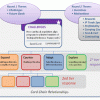
Each year the US Navy spends billions of dollars to maintain and upgrade the readiness of war-fighting systems on its sea-, air-, and land-based platforms. The Navy must find ways to meet its growing maintenance needs at ever lower cost as defense budgets continue to shrink. This requires changes in business relationships between acquisition organizations and their contractors to identify new acquisition strategies, policies, processes, and technical architectures.

Two decades ago, I began my "virtual life" within online worlds -- specifically, what have become known as "social" virtual worlds, "open" virtual worlds, or (my personal favorite) "co-created" virtual worlds.


Ever since the notion of a serious game was spawned by the use of video games like America's Army for serious purposes, there has been a growing acceptance of the importance and relevance of video games and "immersive technologies" as a driver for innovation. Several factors have made these game technologies and strategies successful as innovation tools, including the gradual replacement of immersion with gamification and enabling technologies.
Social collaboration is not about technology. It's about connecting people, and it's changing the way business is being conducted. Similarly, gamification is not about games. It's about motivating the personal and professional behaviors that drive business value. Together, social collaboration and gamification help companies reap great benefits -- among them, the ability to deepen customer relationships, drive operational efficiencies, and optimize their workforce.