



Strategic advice to leverage new technologies
Technology is at the heart of nearly every enterprise, enabling new business models and strategies, and serving as the catalyst to industry convergence. Leveraging the right technology can improve business outcomes, providing intelligence and insights that help you make more informed and accurate decisions. From finding patterns in data through data science, to curating relevant insights with data analytics, to the predictive abilities and innumerable applications of AI, to solving challenging business problems with ML, NLP, and knowledge graphs, technology has brought decision-making to a more intelligent level. Keep pace with the technology trends, opportunities, applications, and real-world use cases that will move your organization closer to its transformation and business goals.
Insight
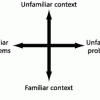
Knowledge needs to be discovered and utilized in context. Creating our own route in our own work context will enable us to develop our personal theory of problem solving in practice, thus making sense of our deliberations and discoveries. Educating learners engaged in professional practice in-the-unfamiliar requires us to abandon the safety of universal theory and embrace the principles of personal discovery, reflective practice, sensemaking, and the development of capability, thereby enabling learners to discover and embrace their own theories and continue to foster and enrich their capability.
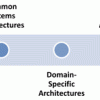

In this Executive Report, we examine these emerging domain architectures and answer the following questions: What are these domain-specific architectures? What impact will they have on EA in general? And, finally, how do they fit with existing architectures and reference models?
Although we talk about "enterprise" architecture, a lot of the most interesting EA work is happening at cross-enterprise levels. Some of this work is initiated by vendors or consulting firms, keen to provide an architectural foundation for their clients. Other cross-enterprise architecture initiatives are developed by groups or consortia specially set up for this purpose.


Although currently limited in its application, streaming analytics technology is going to experience a lot more use as the IoT begins to advance due to its ability to ingest and analyze very high volumes of continuously streaming data (both unstructured and semistructured) in real time. Basically, both of these characteristics are key for sensor data management systems.
Executive Update
Top Down or Bottom Up? Enterprise Data Initiatives in Small Steps
This Executive Update intends to show a pragmatic resolution for the well-known dilemma of top-down versus bottom-up approaches in data warehousing initiatives in light of changing technical, business, and economic scenarios.

Nonfunctional requirements (NFR) are an important aspect of an application, and they are becoming increasingly relevant for Web applications and underlying services. We include in this Executive Update the results of NFR testing at a client site, which shows how the framework is applied to study the system under component failures. Tests revealed system defects, which then could be corrected. A component’s resiliency is estimated using the exception indicator and the Wilson confidence interval.