Strategic advice to leverage new technologies
Technology is at the heart of nearly every enterprise, enabling new business models and strategies, and serving as the catalyst to industry convergence. Leveraging the right technology can improve business outcomes, providing intelligence and insights that help you make more informed and accurate decisions. From finding patterns in data through data science, to curating relevant insights with data analytics, to the predictive abilities and innumerable applications of AI, to solving challenging business problems with ML, NLP, and knowledge graphs, technology has brought decision-making to a more intelligent level. Keep pace with the technology trends, opportunities, applications, and real-world use cases that will move your organization closer to its transformation and business goals.
Insight

Achieving intelligence depends on the ability to query, interpret, and generally "make sense" of growing amounts of information and data stored in repositories.


I am always surprised to find myself in discussions with people who have architect titles and who have little feeling about the key concepts of architecture. Too many members of the current generation of technical experts have very little comprehension of what differentiates systems from programs or services.




The need to consolidate disparate data warehouses and data marts is a situation that many organizations have been forced to deal with. Based on our latest research, approximately 39% of organizations indicate that they have already conducted, or are involved in carrying out, some type of effort to consolidate data warehousing or data marts. It also appears that this trend has accelerated.

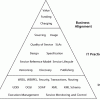

Many service-oriented architecture (SOA) governance initiatives become bogged down in a bureaucracy that militates against the very agility that SOA promises in the first place. Is there a way to achieve agile SOA governance, or is this simply an illusion? Fortunately, our experiences show that there are responsive and practical approaches to SOA governance. As with most things in life, balance is the key.
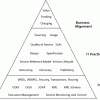
Many service-oriented architecture (SOA) governance initiatives become bogged down in a bureaucracy that militates against the very agility that SOA promises in the first place. Is there a way to achieve agile SOA governance, or is this simply an illusion? Fortunately, our experiences show that there are responsive and practical approaches to SOA governance. As with most things in life, balance is the key.