

Strategic advice to leverage new technologies
Technology is at the heart of nearly every enterprise, enabling new business models and strategies, and serving as the catalyst to industry convergence. Leveraging the right technology can improve business outcomes, providing intelligence and insights that help you make more informed and accurate decisions. From finding patterns in data through data science, to curating relevant insights with data analytics, to the predictive abilities and innumerable applications of AI, to solving challenging business problems with ML, NLP, and knowledge graphs, technology has brought decision-making to a more intelligent level. Keep pace with the technology trends, opportunities, applications, and real-world use cases that will move your organization closer to its transformation and business goals.
Insight


More than half of end-user organizations undertaking business performance management initiatives are required to make changes to existing business processes in order to support implementing their performance management solutions. This finding comes from a Cutter Consortium survey conducted in January 2008 of 101 end-user organizations (based worldwide).

One of the interesting dilemmas facing current IT development managers is what to do with the applications that were written in what used to be referred to as 4GLs (fourth-generation languages). In the 1980s and 1990s, a number of such languages were developed that were designed first to handle management reporting tasks and then to develop basic PC and client-server applications.
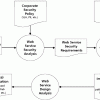

This Executive Update, Part II in a three-part series, discusses approaches to implementing service-oriented architecture (SOA) standards and specifications used for enforcing WS-Security.
The purpose of this Update is to provide guidance and recommendations for securing the SOA infrastructure and further elaborates on the security concepts and standards discussed in Part I (Vol. 11, No. 4).



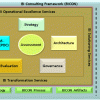
Is there a more structured way of introducing or managing a BI initiative, which cannot only meet the current enterprise needs at various levels but can also sustain the future BI initiatives, in a scalable, standardized, and integrated manner? The answer to this lies in a simple pre-BI initiative: a BI consulting exercise. This exercise is the best opportunity for an organization to assess its BI readiness and also to take itself to the higher levels of the BI maturity model. This Executive Update examines such an exercise.