

Strategic advice to leverage new technologies
Technology is at the heart of nearly every enterprise, enabling new business models and strategies, and serving as the catalyst to industry convergence. Leveraging the right technology can improve business outcomes, providing intelligence and insights that help you make more informed and accurate decisions. From finding patterns in data through data science, to curating relevant insights with data analytics, to the predictive abilities and innumerable applications of AI, to solving challenging business problems with ML, NLP, and knowledge graphs, technology has brought decision-making to a more intelligent level. Keep pace with the technology trends, opportunities, applications, and real-world use cases that will move your organization closer to its transformation and business goals.
Insight
In recent years, a number of seminal books have helped to define the software security field [1, 2, 5]. The approach to "building security in" introduced in these books has been enhanced and expanded by practitioners and published in various technical articles, including the "Building Security In" series in IEEE Security & Privacy.
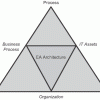

As an IT architect involved in enterprise architecture (EA), I often recall that this branch of IT is not new at all. Rather, it is strictly related to cybernetics,1 a term the Greek philosopher Plato used to refer to "the art of steering" or "the art of government." In 1958, French cybernetics pioneer Louis Couffignal called cybernetics "the art of assuring efficiency of action." Indeed, EA has this final goal: to allow the control and governance of an enterprise.


In April 2006, Cutter Consortium conducted a survey that asked 106 end-user organizations about their use of open source business intelligence (BI) tools. The goal was to determine the degree to which companies are using or planning to use open source BI tools. In particular, the survey was designed to identify the issues and trends being encountered in these efforts and to provide statistics useful for benchmarking and measuring your own organization's use of open source BI tools.

You may know the authors from their Web site, zapthink, which provides analysis on XML, Web services, and service orientation, and which is where I first became aware of the book Service Orient or Be Doomed, by Jason Bloomberg and Ron Schmeltzer.
I was intrigued by the book's catchy title and thought I should give it a look.
Microsoft's announcement that it is developing a new, comprehensive business performance management application called Office PerformancePoint Server 2007 was received like a 500-pound firecracker detonating at a fireworks show. Everyone has been expecting something from Microsoft in the way of a major BI announcement, because of the way it has been aggressively assembling all the necessary pieces for a more comprehensive BI product strategy (either through product development or acquisitions) over the past few years.

I was recently asked to give a talk to a group of Irish software companies about software process improvement (SPI). As I thought about the topic, I realized that to most people, SPI conveys expectations such as deterministic, comprehensive early planning; a detailed process focus; waterfall (serial) lifecycle (planning, requirements, design, etc.); extensive documentation deliverables to show progress; and internal metrics.
Oracle announced last week that it will acquire Demantra Inc., a vendor of demand-driven planning applications that use BI analytics to help manufacturers and retailers predict demand for their products based on seasonality, long- and short-term trends, and promotions and pricing changes. Oracle is expected to finalize the deal later this month; however, financial details were not disclosed.


Domain
Innovation
Assertion 151The application of wikis will increasingly infiltrate forward-thinking, mainstream enterprises in the form of applications that will save these companies money and enable them to collaborate, and therefore innovate, in new ways.