


Strategic advice to leverage new technologies
Technology is at the heart of nearly every enterprise, enabling new business models and strategies, and serving as the catalyst to industry convergence. Leveraging the right technology can improve business outcomes, providing intelligence and insights that help you make more informed and accurate decisions. From finding patterns in data through data science, to curating relevant insights with data analytics, to the predictive abilities and innumerable applications of AI, to solving challenging business problems with ML, NLP, and knowledge graphs, technology has brought decision-making to a more intelligent level. Keep pace with the technology trends, opportunities, applications, and real-world use cases that will move your organization closer to its transformation and business goals.
Insight
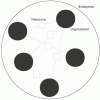

Enterprise architecture (EA) has taken on renewed importance in the past few years. Yet this is in contrast to the fact that EA has largely had a history of failure to deliver on promised value. Much of this disappointment can be traced to a lack of alignment with business drivers and requirements. As enterprise architects, it is incumbent upon us to understand and address these failures and to deliver value that aligns with business goals.
There's a clever saying that goes: "In theory, there's no difference between theory and practice, but in practice there is." This difference was driven home to me on a recent engagement where I spent time with two different groups at the same multinational corporation. In the morning, I discussed SOA with the architecture steering committee (name changed to protect the innocent), where we discussed the issues of SOA and what was needed to realize that potential at the enterprise level.
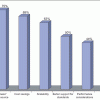

In April 2006, Cutter Consortium conducted a survey that asked 106 end-user organizations about their use of open source business intelligence (BI) tools. The goal was to determine the degree to which companies are using or planning to use open source BI tools. In particular, the survey was designed to identify the issues and trends being encountered in these efforts and to provide statistics useful for benchmarking and measuring your own organization's use of open source BI tools.

At the heart of customer relationship management (CRM) is the customer, and knowing the customer is key. Next month you’ll learn why it's vital to determine not just the customer’s propensity to buy but her capacity to buy — and why companies whose CRM systems leverage broader market data and predictive analytics will surpass those that get their CRM functionality out of a box.
THE FUTURE ISN'T ABOUT WHAT WE'VE ALREADY DONE, BUT WHERE WE CAN GO
Whether based in fact or fiction, the anecdote about the grocer, the old woman, and her dog is legendary among CRM detractors. The woman -- we'll call her Mrs. Brown -- has been buying dog food at a national grocery chain for years. Suddenly, without warning, she stops.
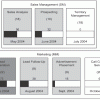

In order to achieve truly agile, innovative organizations, a change in our approach to performance management systems is necessary. This Executive Report introduces a new measurement system, the adaptive performance management system (APMS).
Results of a recent BusinessWeek-Boston Consulting Group survey show that 72% of the senior executives in the survey named innovation as one of their top three priorities [3]. But there is a big gap between wanting innovation and creating the environment in which innovation can flourish.

A key concept of agile project management is that everything has to be field-tested before it gets recommended as a workable technique. One technique I recently decided to put under the magnifying glass is that of keeping a project journal. According to participants on the NewGrange project management list,1 about half of the project managers (PMs) kept some form of journal and half didn't. Those who didn't keep a journal cited two primary reasons: