



Business Transformation Requires Transformational Leaders
Leadership and teaming skills are front and center in times of rapid change. Meet today’s constant disruption head on with expert guidance in leadership, business strategy, transformation, and innovation. Whether the disruption du jour is a digitally-driven upending of traditional business models, the pandemic-driven end to business as usual, or the change-driven challenge of staffing that meets your transformation plans — you’ll be prepared with cutting edge techniques and expert knowledge that enable strategic leadership.
Subscribe to Arthur D. Little's Culture & Leadership Newsletter
Insight
Social business analytics enables organizations to apply real-time sentiment and insights derived from social media and enterprise sources to identify and target key influencers (on social media sites), generate new leads and opportunities, and improve customer loyalty.


Organizations can build resiliency in their employees by helping them successfully adapt to change. Resilient organizations are not satisfied with the status quo and continually seek opportunities for constructive change.
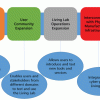
The idea of a Living Lab has emerged over the last few years as a means of deploying an ecosystem that will not only allow the evaluation and fulfillment of requirements in the context of a research project, but will also enable users, experimenters, and practitioners -- from several research domains -- to test and exploit its functionality. Contrary to test beds, which focus on the requirements of the projects that initiate them, a Living Lab supports a greater scope and allows itself to evolve into more mature stages, thus ensuring its applicability for many years.
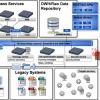
n this article, we present an approach that brings together a new generation of multi-agent systems (MASs) that can build plans and schedules in real time based on the information collected from different resources, including legacy systems (MES, ERP, etc.); data generated by workers, sensors, and the MASs themselves; and enterprise integration platforms that follow different paradigms in order to guarantee fast delivery of business value, maximal coverage of systems accepted by the platform, and security.
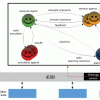
In this article, we briefly describe our view on an ontology-based production management system, focusing particularly on the strategic planning tool. We describe its architecture and present a use case that demonstrates the tool's operability. The difference between our proposed approach and the already existing solutions centers mainly on the use of MASs to provide what-if game simulation to explore different degrees of freedom (DoFs).


This Advisor points out that decision making, which is a critical aspect of the architect's role, is really a management role in disguise, delegated down by senior management. It explains as well that architecture is really a management discipline, even if it doesn't feel quite like one.


As mobile apps become increasingly sophisticated and important, they are changing the ways in which people interact with the IT environment. Mobile apps are accessed differently than is desktop software in that mobile apps are always available and become an immediate part of personal interactions. As they are used for social purposes -- for scheduling and meetings, to access travel details, and to perform innumerable mundane functions that coincide with the needs of ordinary life -- mobile apps leave a rich trail of data that can be exploited, for better or for worse, by companies wishing to enhance their marketing efforts. But these data streams also provide extraordinarily rich pickings for nefarious purposes. Added to this risk is the growing use of business apps that connect to corporate systems and data, creating an increasing security threat across a wide range of vectors.

There is a silent leadership crisis going on right now in many workplaces around the world. The generation shift taking place in the market and the changing needs of the current workplace, including software development teams moving to Agile and its model of "servant leadership," are forcing an older generation of leaders to evolve their leadership styles. This Executive Update explores this leadership crisis from different angles and attempts to point toward areas where leaders can observe their own behaviors and consider new possibilities.