


Business Transformation Requires Transformational Leaders
Leadership and teaming skills are front and center in times of rapid change. Meet today’s constant disruption head on with expert guidance in leadership, business strategy, transformation, and innovation. Whether the disruption du jour is a digitally-driven upending of traditional business models, the pandemic-driven end to business as usual, or the change-driven challenge of staffing that meets your transformation plans — you’ll be prepared with cutting edge techniques and expert knowledge that enable strategic leadership.
Subscribe to Arthur D. Little's Culture & Leadership Newsletter
Insight

While it might sound like a little bit of voodoo, it's not. Prosperity thinking ties back to organizational and group theory from Tuckman to Ouchi. If we adopt a consistent attitude (Ouchi) and it's one where we see the good in the team, the organization, and the world around us (Tuckman), we will have more positive outcomes
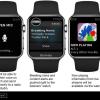

The Apple Watch is significant because it legitimizes the market for wearables (in general) and smart watches (in particular) by dramatically increasing the visibility of smart watches. (Smart watches are wearables designed to run 3rd-party apps; general wearables are fitness bands, activity trackers, and the like, that do not run third-party apps.) It is also leading to a wave of innovative new products -- including apps designed to work with the Apple Watch, as well as new smart watch offerings from other vendors that have been inspired by Apple's innovation. And, perhaps most importantly, the proliferation of smart watch users will offer companies a new and very dynamic touchpoint for engaging with customers.
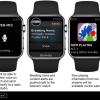
The Apple Watch is the biggest announcement in wearable tech this year. And, in just a few days (24 April), it will start to appear on the wrists of large numbers of consumers.

April 21, 2015 — Arlington, Massachusetts
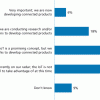
Figure 1 -- How does your organization view the IoT, and connected products in general, in terms of importance?


This Executive Update explores the long-time hiring vs. training debate, which has been energized by an influx of new technologies requiring new skills.
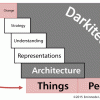

This Executive Update shines a light on the "darkitecture" that envelops architecture, by first observing what enterprises do and then spotting the obvious blind spots indicated by what many organizations ignore.



Most people know that innovation requires time to think, reflect, experiment, fail, revise, and explore. But many have likely not contemplated how directly cost pressures can impact innovation efforts. Psychologist Donald T. Campbell developed a model of innovation in 1960 that can help us understand just what's at stake. The Campbell model was inspired by Darwinian evolution. It portrays innovation as a two-step process, as follows:

Offering connected products can require a company to reinvent itself; in effect, to transform from a product-oriented business into a service-oriented business. Moreover, it is likely that it will also require the business to transition into a software and services provider -- at least to some extent.