



Business Transformation Requires Transformational Leaders
Leadership and teaming skills are front and center in times of rapid change. Meet today’s constant disruption head on with expert guidance in leadership, business strategy, transformation, and innovation. Whether the disruption du jour is a digitally-driven upending of traditional business models, the pandemic-driven end to business as usual, or the change-driven challenge of staffing that meets your transformation plans — you’ll be prepared with cutting edge techniques and expert knowledge that enable strategic leadership.
Subscribe to Arthur D. Little's Culture & Leadership Newsletter
Insight
By now almost every software professional has been exposed to the Agile Manifesto, or at least to its first page containing the value system. But few people have noticed that the Agile Manifesto also contains a second page, with the "Twelve Principles of Agile Development." So if you want to know "how Agile" you are, you should take a look at these principles.
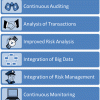

The governance, risk, and compliance (GRC) area has been developing for the past several years toward a more centralized and comprehensive approach. Historically, it has always encompassed an area of large data. Today, it is about to become a focus for big data.

Companies offering Internet-based products and services or online mobile services to their customers should use effective authentication mechanisms for high-risk transactions involving access to customer information or movement of funds to other parties. For the company, it is also important to protect stored cardholder data and encrypt transmission of cardholder data across open, public networks as per popular standards such as PCI DSS. Areas of concern for online commerce can be minimized once the industry gives adequate focus to security issues.

The different ways that supermarkets organize service at the deli counter offer an example of salient transparency. Inefficient supermarkets rely on the mob to self-organize. Customers are expected to form a queue, and the servers have the task of deciding who's next. When approaching the mob, a customer cannot tell whether or how the mob has organized, how long it will take, or who to queue behind. He or she must expend mental energy to establish and maintain position in line and may experience anxiety over whether cutting in line will occur.
Executive Summary
Solving the Right Problems, 2nd Edition (Executive Summary)
The accompanying Executive Report explores some simple actions to alter your thinking and ultimately improve your approach to getting the right things done. We'll talk about two of the most common and far-reaching oversights made by today's CIOs: how we frame the situations we're faced with and how we decide. Every decision we make is greatly impacted by these two tasks.

When we use targets for our indicators of success, they become more than an indicator of how well you are doing -- they become the "goal." The targets supplant the valid goal you created and become more important than the thing they were designed to measure. This is the metamorphosis Martin Klubeck warns you about in this Executive Update.


An examination of the different types of social media analysis practices helps provide a better understanding of their technical capabilities and where they fit in regard to enterprise social analytics needs, as well as how the application of the technology is evolving. There are essentially three main categories of social media analysis practices: social media monitoring, social media listening, and social business analytics. Each provides for increasingly sophisticated analysis of social media data, and each requires the application of increasingly sophisticated technology.
Executive Report
Solving the Right Problems, 2nd Edition
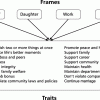
This Executive Report explores some simple actions to alter your thinking and ultimately improve your approach to getting the right things done. The report discusses two of the most common and far-reaching oversights made by today's CIOs: how we frame the situations we're faced with and how we decide. Every decision we make is greatly impacted by these two tasks.