



Business Transformation Requires Transformational Leaders
Leadership and teaming skills are front and center in times of rapid change. Meet today’s constant disruption head on with expert guidance in leadership, business strategy, transformation, and innovation. Whether the disruption du jour is a digitally-driven upending of traditional business models, the pandemic-driven end to business as usual, or the change-driven challenge of staffing that meets your transformation plans — you’ll be prepared with cutting edge techniques and expert knowledge that enable strategic leadership.
Subscribe to Arthur D. Little's Culture & Leadership Newsletter
Insight

This Executive Update examines key trends and developments impacting the adoption of mobile collaboration tools and platforms in the enterprise. Specifically, we consider technology trends and market developments as well as corporate implementation trends.
Cutter: In your new book, Analytics in a Big Data World: The Essential Guide to Data Science and its Applications, you discuss how to target and leverage business opportunities using big data and analytics. Could you expand on what these business opportunities might be?


In this Advisor, Ken Orr asserts that even though nonlinear thinking is not intuitive for everybody, it will help you understand how to get out of significant traps.
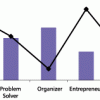

We can have a good deal, a fair contract ... and yet conflict will still arise. This conflict can become quite personal at times. It can even eat into value for money. To explain why some conflict exists and how senior managers might resolve it, this Executive Update discusses the research into the different values and behaviors (called "styles") held and exhibited by the people that develop and manage contracts.


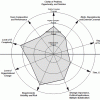

Numerous reports show that a lack of client involvement is the second most critical factor for project failure. ThisExecutive Report introduces a complex project team structure and four co-manager models for use in complex project management (along with briefly describing a fifth variation). One co-manager is from the development side. The other is from the product side. The report describes all the models, along with when and how to use them.
Complex projects have either a goal or a solution or both that cannot be clearly defined at the start of the project. There are nine dimensions present to varying degrees in every project. The level of complexity is measured along each dimension.