Business Transformation Requires Transformational Leaders
Leadership and teaming skills are front and center in times of rapid change. Meet today’s constant disruption head on with expert guidance in leadership, business strategy, transformation, and innovation. Whether the disruption du jour is a digitally-driven upending of traditional business models, the pandemic-driven end to business as usual, or the change-driven challenge of staffing that meets your transformation plans — you’ll be prepared with cutting edge techniques and expert knowledge that enable strategic leadership.
Subscribe to Arthur D. Little's Culture & Leadership Newsletter
Insight

Most news coverage of drones focuses on their use by the military -- especially US forces in the Middle East, where they are used in combat and anti-terrorist operations. Amazon also managed to get a lot of free publicity around the 2013 holiday season when company reps suggested the company might use drones to deliver packages to consumers in the future.


Serious games provide an attractive alternative to traditional innovation techniques for both participants in the innovation process: technology producers and technology consumers. Whether or not producers and consumers behave like innovation partners, or even realize they are engaged in this partnership, innovation does require at least two participants to play. In the best of all possible partnerships, there is a smooth collaboration between the two players, but, as you'll discover in this issue of Cutter IT Journal, this often this isn't the case.
Innovation is the primary driver of sustained business and societal success. Essentially, innovation involves the discovering of unmet, inadequately met, or unarticulated market, organizational, or societal needs and the offering of better products, processes, services, technologies, or ideas to meet those needs. The challenge lies in identifying the needs and designing and implementing solutions that have high market desirability.
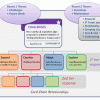
Each year the US Navy spends billions of dollars to maintain and upgrade the readiness of war-fighting systems on its sea-, air-, and land-based platforms. The Navy must find ways to meet its growing maintenance needs at ever lower cost as defense budgets continue to shrink. This requires changes in business relationships between acquisition organizations and their contractors to identify new acquisition strategies, policies, processes, and technical architectures.

Two decades ago, I began my "virtual life" within online worlds -- specifically, what have become known as "social" virtual worlds, "open" virtual worlds, or (my personal favorite) "co-created" virtual worlds.


Ever since the notion of a serious game was spawned by the use of video games like America's Army for serious purposes, there has been a growing acceptance of the importance and relevance of video games and "immersive technologies" as a driver for innovation. Several factors have made these game technologies and strategies successful as innovation tools, including the gradual replacement of immersion with gamification and enabling technologies.
Social collaboration is not about technology. It's about connecting people, and it's changing the way business is being conducted. Similarly, gamification is not about games. It's about motivating the personal and professional behaviors that drive business value. Together, social collaboration and gamification help companies reap great benefits -- among them, the ability to deepen customer relationships, drive operational efficiencies, and optimize their workforce.