


Business Transformation Requires Transformational Leaders
Leadership and teaming skills are front and center in times of rapid change. Meet today’s constant disruption head on with expert guidance in leadership, business strategy, transformation, and innovation. Whether the disruption du jour is a digitally-driven upending of traditional business models, the pandemic-driven end to business as usual, or the change-driven challenge of staffing that meets your transformation plans — you’ll be prepared with cutting edge techniques and expert knowledge that enable strategic leadership.
Subscribe to Arthur D. Little's Culture & Leadership Newsletter
Insight
Enterprise 3.0 is about trends -- and outcomes. It's about radical changes that, taken together, move us away from silly debates about business technology "alignment" and closer to business technology convergence.

EA Is Catching Up with Reality
Enterprise architecture is finally becoming a mature, mainstream activity in large organizations. This includes controlling complexity and aligning to the business in light of current realities such as outsourcing.
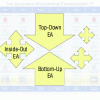

Enterprise architecture (EA) practices1 have evolved and matured significantly over the past two decades. However, EA as a discipline continues to be largely misunderstood by management, who questions its value, and EA initiatives still often fail to achieve actionable outcomes.


Abstract
By now, agile methodologies have become established as a means of correcting a variety of ills within the software development environment. The next step is to move them to center stage within the enterprise.

Agile methodologies have moved forward considerably since they first appeared in the 1990s, but implementation as standard practice within the enterprise has lagged.


This is the final Executive Report in a four-part series by Dr. Sara Cullen on the outsourcing lifecycle. The series is based on a detailed understanding of the outsourcing experiences of 107 organizations. This report takes you through the last three building blocks focused on transition, management, and the next generation (that is, the next contract). It is during these building blocks that the work done (or not done!) in the earlier part of the lifecycle, discussed in the previous Executive Reports, can hit hard. And even if done well, there are many challenges, as you will see.
This is the final Executive Report in a four-part series by Dr. Sara Cullen on the outsourcing lifecycle. The series is based on a detailed understanding of the outsourcing experiences of 107 organizations. This report takes you through the last three building blocks focused on transition, management, and the next generation (that is, the next contract). It is during these building blocks that the work done (or not done!) in the earlier part of the lifecycle, discussed in the previous Executive Reports, can hit hard. And even if done well, there are many challenges, as you will see.


Domain
Innovation
Assertion 187:Companies have pursued efficiency, economies of scale, and mass markets at the expense of products that excite consumers and promote loyalty. The upside has been declining unit-cost curves, which have allowed products to reach consumers at prices more affordable than ever before. However, the downside has been a series of "me, too" products that fail to inspire.