


Business Transformation Requires Transformational Leaders
Leadership and teaming skills are front and center in times of rapid change. Meet today’s constant disruption head on with expert guidance in leadership, business strategy, transformation, and innovation. Whether the disruption du jour is a digitally-driven upending of traditional business models, the pandemic-driven end to business as usual, or the change-driven challenge of staffing that meets your transformation plans — you’ll be prepared with cutting edge techniques and expert knowledge that enable strategic leadership.
Subscribe to Arthur D. Little's Culture & Leadership Newsletter
Insight

Outsourcing can be an important asset in the firm's arsenal, but it is no panacea, and it must be proactively managed. This very realization is what motivated our interest in an issue entirely dedicated to the client-vendor relationship in the IT outsourcing context.
BACKGROUND OF CLIENT-VENDOR RELATIONSHIPS
We first address the central challenge facing client-vendor relationships and then look at the evolution of these relationships.

This installment of CBR focuses on one of the most enduring issues in IT management for both practice and research: IT outsourcing and the management of the client-vendor relationship. Helping us navigate the topic are experts from both the academic and the practice sides of this important issue. Our academic contributors are David Murungi and Santiago Peña, PhD students at the E.J.
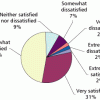

SURVEY DEMOGRAPHICS
This survey investigated client-vendor contract and relationship management. Eleven percent of the 45 responding organizations have more than 50,000 employees, 7% have between 10,000 and 50,000 employees, 27% have between 1,000 and 10,000 employees, 36% have between 100 and 1,000 employees, and the remaining organizations have 100 or fewer employees.


A big idea, that collaborative innovation requires us to reconceive our idea of "failure," seems to be taking hold. We're getting it that an iterative process will include segments that don't achieve closure, don't solve the problem, aren't ready for the market. We're getting it that, since we can't foresee an emergent outcome, we have no way of knowing when exactly we'll get there.