


Business Transformation Requires Transformational Leaders
Leadership and teaming skills are front and center in times of rapid change. Meet today’s constant disruption head on with expert guidance in leadership, business strategy, transformation, and innovation. Whether the disruption du jour is a digitally-driven upending of traditional business models, the pandemic-driven end to business as usual, or the change-driven challenge of staffing that meets your transformation plans — you’ll be prepared with cutting edge techniques and expert knowledge that enable strategic leadership.
Subscribe to Arthur D. Little's Culture & Leadership Newsletter
Insight
A big idea, that collaborative innovation requires us to reconceive our idea of "failure," seems to be taking hold. We're getting it that an iterative process will include segments that don't achieve closure, don't solve the problem, aren't ready for the market. We're getting it that, since we can't foresee an emergent outcome, we have no way of knowing when exactly we'll get there.






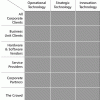

Pendulums swing back and forth in lots of areas. This is especially true in corporate and technology governance. But it may stop swinging for good very soon. Let's look at why things are so different now -- and likely to stay that way forever.
THE OLD DEFINITIONLet's begin with a definition of technology governance. Wikipedia describes it as:


In his book Business Agility: Sustainable Prosperity in a Relentlessly Competitive World, Michael Hugos, who is also a columnist for CIO magazine, talks about two fundamental business strategies: responsiveness and efficiency.


Our two-decades-old World Wide Web architecture is long past due for an upgrade. During what we might call the "Web 1.0-2.0 epoch," demand for computing has grown across every enterprise, in every sector, around the globe. We continue to struggle to meet this demand using our traditional approaches to building and managing enterprise information systems.
Executive Update
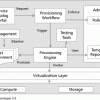
Cloud-Based, On-Demand Test Platform
Cloud computing is the most talked about emerging technology trend today. The National Institute of Standards and Technology (NIST) defines cloud computing as "a model for enabling convenient, on-demand network access to a shared pool of configurable computing resources (e.g., networks, servers, storage, applications, and services) that can be rapidly provisioned and released with minimal management effort or service provider interaction." 1