

Strategic advice to leverage new technologies
Technology is at the heart of nearly every enterprise, enabling new business models and strategies, and serving as the catalyst to industry convergence. Leveraging the right technology can improve business outcomes, providing intelligence and insights that help you make more informed and accurate decisions. From finding patterns in data through data science, to curating relevant insights with data analytics, to the predictive abilities and innumerable applications of AI, to solving challenging business problems with ML, NLP, and knowledge graphs, technology has brought decision-making to a more intelligent level. Keep pace with the technology trends, opportunities, applications, and real-world use cases that will move your organization closer to its transformation and business goals.
Insight
Many healthcare CIOs find themselves caught between technological imperatives and public policy on one hand and internal resistance to change on the other. Some healthcare CIOs who have undertaken massive, IT-driven transformation efforts are confronting serious challenges, from technological hurdles to their own staff's determination that patients, not processes, remain the foremost priority. What many institutions have created is a hodgepodge of healthcare IT (HIT) systems that partially automate their operations and processes without regard to the long-term benefits of these systems. Despite implementing mammoth electronic medical record (EMR) systems and building a host of advanced clinical systems, healthcare CIOs often have been dismayed to find that many of these projects fail completely or don't bring about the desired results.

Currently, software systems in the healthcare domain are not sufficient to alleviate this crisis. Most of those systems are not extensible or scalable, and they have little interoperability. In this article, I will show how IT analysis methods can help alleviate the crisis by providing tools to build IT software systems that will reduce cost and complexity in the healthcare domain.



In this Executive Update, we will explore how apps and open data combine to create new ways of working for both developers and users and some of the issues, problems, and benefits of working with these new tools and techniques.




The world of network regulation is exceedingly murky, yet it is of critical importance as much to business as to the consumer. Technological advances along with changes in the competitive field are forever challenging or amending regulations, as we'll explore in this Executive Update.

We hear of few organizations that debate whether the enterprise needs a marketing function. However, there is interminable wrangling about the value proposition for EA, and considerable effort devoted to crafting and articulating persuasive arguments for EA's existence. It is obvious that value propositions are necessary only because EA's value is not readily apparent.
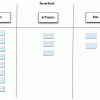


This Executive Report is an opinion piece on Scrum versus Kanban. Lead author Johanna Rothman sets forth her argument that one is not necessarily better than the other; they are just different and it’s up to the organization to figure out which method is best under which circumstance. In response, seven of Cutter’s Agile experts discuss their views on crossing the Agile divide.