


Strategic advice to leverage new technologies
Technology is at the heart of nearly every enterprise, enabling new business models and strategies, and serving as the catalyst to industry convergence. Leveraging the right technology can improve business outcomes, providing intelligence and insights that help you make more informed and accurate decisions. From finding patterns in data through data science, to curating relevant insights with data analytics, to the predictive abilities and innumerable applications of AI, to solving challenging business problems with ML, NLP, and knowledge graphs, technology has brought decision-making to a more intelligent level. Keep pace with the technology trends, opportunities, applications, and real-world use cases that will move your organization closer to its transformation and business goals.
Insight
Abstract
Ontology engineering is now a desirable skill for professionals working in IT as well as for managers who have to weigh the costs of related projects. It consists of a complex combination of specialized activities and is a bit of an art as well as a science.
The software engineering practice is merely half a century old, but a great deal of development has occurred in this relatively short time. It is interesting to notice that as systems have gradually become more complex, sophisticated, and larger, code has become more efficient (e.g., more functionality per line of code), and software development methodologies have tended to become leaner and more agile.


We all feel the pressure from today's economic climate. Business strategy has shifted to a straightforward focus: survive the current downturn. Interestingly, this coincides with the 150th anniversary of the publication of Darwin's The Origin of Species.
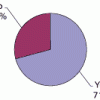

This is the third in a series of Executive Updates examining the results of a recent Cutter Consortium survey on the subject of open source Java frameworks (OSJFs). Part I1 revealed that Java EE's platform neutrality is considered its greatest strength, followed by tool support, scalability, maturity, and robustness.



I recently received a large architecture document to review. After poring through a few hundred pages of text and drawings, I was impressed by how much work and thought had gone into it yet how utterly useless it was. Now, don't get me wrong: it's not that architecture is unimportant; quite the opposite. The classic, big architecture document is just the wrong way to deliver it. I had hoped that the industry had gotten past these kinds of deliverables; apparently I was wrong.



I recently received a large architecture document to review. After poring through a few hundred pages of text and drawings, I was impressed by how much work and thought had gone into it yet how utterly useless it was. Now, don't get me wrong: it's not that architecture is unimportant; quite the opposite. The classic, big architecture document is just the wrong way to deliver it.