
CUTTER BUSINESS TECHNOLOGY JOURNAL VOL. 34, NO. 5

Jayashree Arunkumar outlines how five AI trends are being slotted into real-world use, including graph-accelerated ML, generative AI, edge AI, artificial general intelligence, and coding. Arunkumar then examines how AI is helping the environment by accelerating the pace of delivering on the United Nation’s Sustainability Development Goals and how it might apply similar tactics to help improve world health. The article closes with four of the most recent AI developments.
Technology is not the solution to all our problems, but artificial intelligence (AI) does have the potential to transform the way we conduct our everyday lives. Which begs the question: just how powerful are today’s AI solutions, and which areas are showing the most promise? The answer lies in five interesting AI trends and how that technology is being slotted into real-world use. It also lies in several AI projects aimed at helping the environment and how similar efforts might be used to improve healthcare.
5 AI Trends: 2021 and Beyond
1. Composite AI
Composite AI involves combining multiple AI techniques to achieve a better outcome. For example, graph-accelerated machine learning (ML) helps optimize AI models and speed up AI processes.1
There are three steps to building graph-accelerated ML models:
-
Aggregate data from a variety of sources using a tool such as Apache Spark (open source).
-
Build out the graph and view possible data relationships using a graph database tool such as Neo4j.
-
Send the completed graph to the ML pipeline.
Leading organizations like Amazon, Google, and Facebook are using graph-accelerated ML to develop recommendation systems, combinatorial optimization, and computer imaging, respectively.2 The context that graphs can add to AI applications means we’re likely to see an increase in roles like graph AI engineer, ontology engineer, and AI ethicist in the near future.
Here are a few use cases for data science graphs:
-
Query-based knowledge graphs
-
AstraZeneca uses knowledge graphs to build its understanding of disease.3
-
NASA uses knowledge graphs to extract knowledge from its Lessons Learned database.4
-
-
Query-based feature engineering
-
Hetionet is an open source heterogeneous information network of biomedical knowledge. It uses query-based feature engineering to help scientists predict whether a compound will have an effect on a disease, helping them explore new uses for existing drugs.5
-
-
Graph embeddings
-
Amazon’s DGL-KE helps make knowledge graph embeddings easier to use.6
-
-
Graph neural networks
2. Generative AI
Generative AI refers to the technique of generating new sample data (picture, voice, or text) from a training data set. The model looks at a sample training data set to evaluate how it was created and uses the probability distribution to generate completely new samples. For example, given a set of images of people’s faces, a generative model can create photos of imaginary people by inferring from the probability distribution of the training data set.
There are two neural networks involved in this process. One is called the “generator”; the other is the “discriminator.” During training, the generator creates the fake data, and the discriminator classifies it as fake. The generator iteratively improves the quality of the fake data until the discriminator identifies the fake content as real.
Here are some generative AI use cases:
-
Dental restoration. Generative AI can be used to design dental crowns, improving fit and reducing the number of times the patient must visit the dentist during the process.
-
Life support. A NASA contractor used this technique to optimize the design of astronauts’ life support backpacks. The design engine allowed the engineering team to explore multiple options that fit within the project’s defined constraints to generate the most effective design.11
-
Improve space medicine. NASA scientists developed a way to use AI-synthesized biosensor data to simulate potential health conditions that could impact astronauts.12
-
Automated videos. Reuters worked with AI startup Synthesia to create a fully automated presenter-led sports news summary system.13
The downside of generative AI is its potential use by hackers and other bad actors. For example, the CEO of a UK energy company transferred money to a supplier based on a phone call in which he believed he was talking to his boss at the firm’s parent company.14
To prevent this type of crime, organizations will need tools such as Microsoft Video Authenticator, which can help users detect manipulated photos and videos.15
3. Edge AI
Smart devices are expected to generate as much as 175 zettabytes of data by 2025.16 This volume will create challenges for cloud storage, data transmission, and data processing.
Edge computing eases this burden and lowers latency by bringing storage and processing closer to the location where it’s needed. The data generated still needs to be analyzed, of course, so AI capabilities are being developed and hosted on local edge servers.
5G networking will be needed to support these connections. Although still in its nascent stage, 5G will mature considerably and become mainstream in the next five years or so. The combination of edge computing, edge cloud, 5G, AI, and open source will drive advanced solutions just now being considered.
Edge AI has four domains:
-
Edge caching
-
Edge training
-
Edge inference
-
Edge offloading
Table 1 describes the most common edge use cases and the edge domains associated with them.
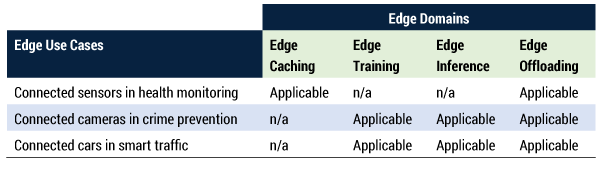
The biggest challenge in developing edge AI solutions is achieving high performance, given the constraints of today’s Internet of Things devices. The next challenge is scaling complex applications. For example, hundreds of cameras and sensor nodes can be installed in a city setting, but scaling the edge solution in such a setup is complex. To address these challenges, researchers have proposed a combination of specialization design methods (on-device training, software design, hardware design, automation) and co-design methods (software/hardware co-design, software/compiler co-design, hardware/compiler co-design).
Technical guidelines around privacy, security, and environmental considerations for future developments in edge AI are also in the exploratory stage.
4. Artificial General Intelligence
Currently, AI solutions are fairly narrow. For example, the AI designed for self-driving cars can’t be used to drive a truck or motorcycle. To get to the next level, AI must be able to educate itself and learn like humans, a characteristic usually referred to as artificial general intelligence (AGI). (AI that can surpass human intelligence is referred to as artificial superintelligence.) Table 2 shows the three stages of AI development.
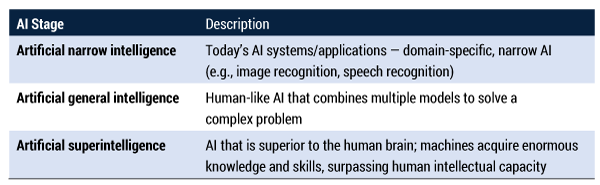
In its simplest form, AGI consists of thousands of ML models working together to solve a complex problem. AGI is all about building a human-like system. Indeed, the AI solutions we see today are not really AI; they don’t have flexible, general-purpose intelligence.
However, there are some interesting developments in this area. Given the pace of development in the last decade, futurist Ray Kurzweil predicts we’re about 10 years away from AGI. Kurzweil predicts AGI will likely pass a valid Turing test by 2029 and surpass human intelligence by 2045.17
The most prominent AGI systems right now are OpenNARS, OpenCog, and AERA:
-
OpenNARS (Open Non-Axiomatic Reasoning System) is an open source, general-purpose AI system that focuses on building a thinking machine.
-
OpenCog is an open source project focused on building AGI capabilities that are equivalent to, or better than, human capabilities. It is novel architecture for AGI, based on a hypergraph knowledge store called AtomSpace.
-
AERA (auto-catalytic endogenous reflective architecture) demonstrates numerous operational features necessary to achieve AGI using domain-independent learning, cumulative incremental learning, transfer learning, time-sensitive resource management, and long-term scalability.
On the corporate side, Microsoft is working with OpenAI to develop human-like solutions, and Google DeepMind is working to advance AGI.
5. AI and Coding
AI has some interesting roles to play in coding. The first is in finding and fixing human errors in code to help products get to market faster and with fewer problems. This approach frees up engineers to work on contextualization, customization, and problems involving deep logic requiring human intervention. Here are some examples:
-
SketchAdapt is a framework developed by MIT that combines pattern matching and symbolic search techniques to generate high-level program structure and low-level detailed coding. An MIT study found the framework performs better than Microsoft DeepCoder.18
-
Code processing tools like Eclipse and Visual Studio have built-in language models that can help engineers by proposing pluggable code snippets. The problem is that these tools don’t currently guard against hackers injecting variables into the snippets that can harm the application in production. IBM and MIT co-developed a tool that can spot the weak points in the code generated by code processing tools and ensure robustness against adversarial attacks.19
-
Intel worked with MIT and the Georgia Institute of Technology to develop an automated engine that can improve engineering productivity by learning what the code is trying to accomplish and providing recommendations for optimal ways to get to the goal.20
The second role for AI is in no-code platforms that allow citizen developers to create apps on their own, without IT. Google, Apple, Microsoft, and Amazon all rolled out no-code AI solutions between 2017 and 2020, and 12 coding/AI-related venture capital–backed companies received funding in 2020 (amounts ranged from US $2 million to $750 million).21
How AI Helps the Environment
In 2015, the United Nations set forth a series of Sustainability Development Goals (SDGs) intended to “achieve a better and more sustainable future for all.”22 Digital technology will be critical to meeting those goals, and AI has the potential to dramatically speed up their delivery. AI can accelerate the pace of delivering SDG goals at scale. Here are two examples:
-
Google. AI applications in the area of wind and solar power from Google DeepMind is a step change toward renewable energy goals. In 2019, Google launched an accelerator program that supports tech startups that support SDG goals.23
-
Microsoft. Glacier melting is directly related to climate change, perhaps today’s most pressing global concern. Microsoft’s AI for Good Research Lab is working with several organizations to understand the extent of glacier melting in the Himalayas and how to minimize its impact.24 Microsoft has also outlined plans to further align its technology initiatives to SDGs.25
These efforts are excellent first steps, but there’s a great deal of work still to be done to harness the power of AI in addressing environmental issues. For example, McKinsey analyzed 160 AI social-impact use cases and identified 10 domains where adding AI could have a significant impact.26 Unfortunately, the framework includes only one use case in life below water and two use cases across affordable and clean energy and clean water and sanitation. That leaves multiple SDGs still needing to be looked at from an AI-application perspective.
Here are some potential environmental use cases identified in a 2020 workshop hosted by Stanford University’s Institute for Human-Centered AI (HAI):27
-
Use satellite tracking and digital data streams to identify ships involved in human trafficking.
-
Create food-choice recommendations to enable consumers to help protect the environment.
-
Determine optimal water allocation based on environmental constraints.
-
Optimize agriculture returns through early detection of crop disease and other issues.
Unprecedented collaboration between academia, corporations, and governments is needed to accelerate the use of AI to solve our environmental challenges.
How AI Could Aid Healthcare
There’s an enormous potential for AI in patient care. One example is intelligent equipment logistics, something that would have been extremely useful during the pandemic when hospital beds, oxygen tanks, and respirators were in short supply. Many of these resources could have been moved from place to place as cases spiked if better and more integrated logistics systems were available. Human resources like physicians and nurses could have been tracked and “allocated” nationwide rather than every healthcare system having to grapple with staffing shortages on their own. Vaccines could also be expedited more efficiently using AI systems. Indeed, during the spring 2021 COVID outbreak in India, several startups began piloting conversational AI solutions aimed at improving logistics.28
Home care is another example of an area that’s especially important as populations age. Systems that combine sensors (monitoring blood pressure, blood sugar levels, etc.) with intelligent analytics could be used to create better outcomes for home-bound patients, not to mention the boon they’d be to home health workers and family caregivers. Likewise, today’s telemedicine solutions are fairly simplistic and could be developed into interactive solutions for virtual care using AI.
The pharmaceutical industry can also benefit from AI, as demonstrated by AI startup PostEra, which organized COVID Moonshot.29 This crowdsourced initiative invited submitted drug designs, used its ML tools to determine which ones should be tested, and arrived at a potential antiviral in 48 hours, a task that would have taken weeks using traditional methods.
Recent AI Developments
If there are any doubts about the potential for AI to permanently change our lives, we have only to look at the most recent technology developments. To close out this article, here are just a few:
-
Facebook AI recently made public a data set consisting of 45,186 videos of 3,011 humans having conversations. The tool is expected to help researchers better understand racial bias in technology and explore solutions to ensure fairness in AI.30
-
Facebook also released a recommendation system that uses 12 trillion parameters to speed AI-model training time by 40x.31
-
Waymo (formerly Google’s self-driving car program) has released what it calls the largest interactive data set yet released for research into behavior prediction and motion forecasting for autonomous driving.32
-
GPT-3 and Eleuther, both open source language algorithms, are capable of writing coherent articles in English when given a text prompt.33
Disclaimer: The ideas expressed in this article are based on the author’s industry experience. Wipro does not subscribe to the substance, veracity, or truthfulness of said opinion.
References
1Hodler, Amy E. “AI and Graph Technology: 4 Ways Graphs Add Context.” Neo4j, 29 July 2019.
2Ivanov, Sergei. “Top Applications of Graph Neural Networks 2021.” Criteo R&D Blog, 14 January 2021.
3Bendtsen, Claus, and Slavé Petrovski. “How Data and AI Are Helping Unlock the Secrets of Disease.” AstraZeneca, 1 November 2019.
4Meza, David. “How NASA Finds Critical Data Through a Knowledge Graph.” Neo4j, 17 May 2017.
5Hetionet.
6Zheng, Da. “Amazon’s Open-Source Tools Make Embedding Knowledge Graphs Much More Efficient.” Amazon Science, 6 August 2020.
7Fabula AI is a London, UK-based fake news detection company owned by Twitter; see Wikipedia’s “Fabula AI.”
8Zhu, Rong, et al. “AliGraph: A Comprehensive Graph Neural Network Platform.” Cornell University, 23 February 2019.
9GraphSAGE on GitHub, accessed May 2021.
10DeepMind.
11“Jacobs Takes Product Design to New Heights with Generative Design in Aerospace.” Case study, PTC, accessed May 2021.
12Mackintosh, Graham. “AI Applications for Astronaut Health.” NASA, 7 October 2020.
13Chandler, Simon. “Reuters Uses AI to Prototype First Ever Automated Video Reports.” Forbes, 7 February 2020.
14Damiani, Jesse. “A Voice Deepfake Was Used to Scam a CEO Out of $243,000.” Forbes, 3 September 2019.
15Khan, Faisal. “‘Video Authenticator’ Is Microsoft’s Answer to Deepfake Detection.” Technicity, 11 September 2020.
16Coughlin, Tom. “175 Zettabytes by 2025.” Forbes, 27 November 2018.
17See Wikipedia’s “Predictions Made by Ray Kurzweil.”
18Martineau, Kim. “Toward Artificial Intelligence That Learns to Write Code.” MIT News, 14 June 2019.
19Srikant, Shashank, et al. “Generating Adversarial Computer Programs Using Optimized Obfuscations.” OpenReview.net, 28 September 2020.
20“Intel, MIT, and Georgia Tech Deliver Improved Machine-Programming Code Similarity System.” Intel Newsroom, 29 July 2020.
21“No-Code AI Startups Are Raising Funding & Getting Acquired. Why App Developers & Big Tech Cos Think Plug-and-Play AI Coding Tools Could Be a Game Changer.” Research Brief, CB Insights, 19 April 2021.
22“Take Action for the Sustainable Development Goals.” United Nations, accessed May 2021.
23“Sustainable Development Goals.” Google for Startups, accessed May 2021.
24Fleming, Seán. “Tracking the Effects of Glacial Melting at the Top of the World.” On the Issues, Microsoft, 12 January 2021.
25Art, Jean-Yves, et al. “Microsoft and the United Nations Sustainable Development Goals.” Microsoft, September 2020.
26Chui, Michael, et al. “Notes from the AI Frontier: Applying AI for Social Good.” McKinsey Global Institute, December 2018.
27Maher, K. “Environmental Intelligence: Applications of AI to Climate Change, Sustainability, and Environmental Health.” Stanford University, Human-Centered Artificial Intelligence (HAI), 16 July 2020.
28Bhavani, Divya Kayla. “Conversational IT Becomes the Unlikely Hero During the COVID-19 Pandemic.” The Hindu, 11 May 2021.
29“COVID Moonshot.” PostEra, accessed May 2021.
30“Shedding Light on Fairness in AI with a New Data Set.” Facebook AI, 8 April 2021.
31Alford, Anthony. “Facebook Announces ZionEx Platform for Training AI Models with 12 Trillion Parameters.” InfoQ, 4 May 2021.
32Hawkins, Andrew J. “Waymo Is Disclosing More Autonomous Vehicle Data for Research Purposes.” The Verge, 10 March 2021.
33Knight, Will. “This AI Can Generate Convincing Text — and Anyone Can Use It.” Wired, 29 March 2021.