
AI is reshaping the business landscape at an unprecedented pace — redefining speed, value creation, and competitive dynamics. It is forcing organizations to accelerate innovation faster than ever. As a result, executives face a new organizational paradox: continuously improving and stabilizing the core business while simultaneously disrupting, innovating, and building the future. What once was a strategic choice has become, in the age of AI, a condition for survival.
Between Efficiency & Disruption: The Managerial Dilemma of the AI Era
AI delivers unmatched levels of precision, personalization, automation, and operational efficiency. It enables organizations to analyze massive data volumes, predict demand, optimize supply chains, and deliver more tailored products and services. In doing so, AI strengthens the existing business model and accelerates exploitation-driven innovation — the continuous improvement, enhancement, and scaling of what already works.
At the same time, these very capabilities trigger the emergence of new business models, disruptive ideas, and fast-moving competitors. AI becomes a powerful force that compels organizations to rethink their identity, value proposition, and strategic trajectory.
This dual effect creates a managerial reality in which AI simultaneously amplifies two competing forces: the need to optimize and the pressure to transform. The challenge is not choosing one, but leading both, at the same time.
Dual Innovation: A Critical Capability in the Age of AI
Organizational ambidexterity — the ability to manage both exploitation and exploration — has long been recognized as a key driver of sustained success. The concept, developed by Charles O’Reilly (Stanford) and Michael Tushman (Harvard), and detailed in Lead and Disrupt — How to Solve the Innovator’s Dilemma, demonstrates that companies focusing solely on one capability fade over time (Kodak, Blockbuster, DEC), while those mastering both sides consistently thrive (IBM, Amazon, Google, Netflix). Business reality concurs: corporate life expectancy has declined from around 90 years to roughly 50 and continues to shrink as disruption accelerates.
How AI Strengthens Both Sides of Innovation
AI expands an organization’s ability to innovate across both domains:
- Enhancing and optimizing the existing business (exploitation)
-
Enables advanced analytics for data-driven decision-making
-
Personalizes and improves customer experience
-
Automates and optimizes processes
-
Improves demand forecasting, inventory management, and supply chain
- Exploring new business models and opportunities (exploration)
-
Supports ideation and business model innovation
-
Runs simulations, feasibility assessments, and scenario analysis
-
Accelerates product/service development
-
Identifies opportunities, ecosystems, and partnerships
In doing so, AI empowers organizations while also deepening the gap between the two worlds, making coordinated leadership essential.
Leading 2 Tracks Simultaneously
Exploitation is structured and linear. It relies on planning, control, and predictable change.
Exploration is open-ended, chaotic, and uncertain. It requires curiosity, cognitive openness, courage, and the ability to tolerate ambiguity and failure — see Figure 1.
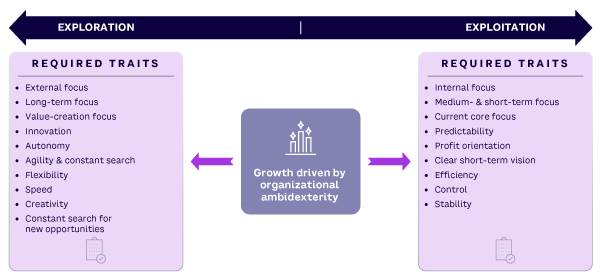
These two modes may appear contradictory, but in the AI era, they operate concurrently and continuously. It is therefore no surprise that many organizations struggle to become truly ambidextrous. The real challenge today is not merely “adding innovation” but managing the ongoing tension between order and chaos. Leaders who succeed will steer both the present and the future, not as separate tracks, but as one interdependent system that requires deliberate navigation.
Putting Dual Management into Practice
The Bimodal Management model provides executives with a practical framework for advancing both innovation modes without collapsing into one at the expense of the other. Three guiding principles help operationalize this approach:
-
Plan while moving. In a constantly evolving environment, planning and execution must advance in parallel. Continuous adjustment of direction enables long-term clarity alongside rapid response to emerging data and shifting conditions.
-
Maintain stability in core operations while enabling innovation and renewal at the edges. Innovation requires solid foundations and creative freedom. Agile units connected to the core allow experimentation and discovery without compromising consistency and control.
-
Treat experimentation as a growth engine. Fast experimentation and real-time learning accelerate innovation. Failure becomes a natural step in the improvement cycle, not a managerial threat.
Beyond Balance: Mastering the Movement
AI is not merely a technology. It is an organizational catalyst that compels leadership teams to accelerate innovation and stabilize the core simultaneously. The right managerial approach in the age of AI is not choosing between exploitation and exploration but mastering the dynamic movement between them.
Innovation in the AI era is not a linear process; it is a living system of planning, learning, experimenting, and adjusting — all happening concurrently. Sustainable innovation will not emerge from algorithms alone, but from leaders capable of seeing both realities at once: the stable and the emerging, the certain and the uncertain. That is the essence of dual management — and a key leadership imperative in the AI era.