AMPLIFY VOL. 38, NO. 7

I was standing in a hallway in 2009 when a breathless team member delivered the news: the new leadership team had canceled every initiative we’d built. Not because they failed. They were working: engagement was up, business continuity protocols were solid, and the frameworks were doing exactly what they were designed to do.
But the new executive didn’t see that. He saw his past. He had lived through a similar initiative at a previous company that became a political liability. Through that lens, our progress looked like failure repeating to him. Within a few weeks, he had dismantled everything.
That moment revealed what I’d later call the “projection trap.” It changed how I understood resilience forever.
Resilience doesn’t fail because frameworks fail. It fails because leaders react to mental projections instead of reality.
Perception is never neutral. We don’t see situations as they are. We see them as we are. Every belief, fear, and past experience colors what we perceive in the present. Each interpretation we add is the mind’s attempt to make sense of uncertainty and regain control.
The shift begins the moment a leader pauses and asks, ”What am I adding to this picture?” That simple question interrupts the automatic loop of projection. It reveals how much of what we’re reacting to is our own narrative, not reality itself. From that awareness, clarity begins to return. Until leaders see this, every attempt to design resilience will quietly generate the opposite: fragility.
Here’s the mechanism: fear-based thoughts don’t just influence decisions. They construct the systems themselves. When you think, “We’re not prepared,” you generate defensive structures embodying that fear. The framework becomes a monument to anxiety.
This is why more planning isn’t the answer. You’re using fear to defend against fear. The quality of thought creating your resilience framework determines whether it generates adaptability or brittleness.
Of course, this isn’t an argument against planning. Strategic planning has its place. The distinction is that healthy planning responds to actual conditions and stays flexible. Projection-based planning defends against imagined futures and becomes rigid. The question isn’t whether to plan, but whether your planning emerges from perception or projection.
Your body knows the difference. Projection feels like chest tightness and compulsive control. Perception feels spacious even in crisis. Check your physical state — it reveals whether you’re reacting to mental projections or responding to reality.
The Resilience Paradox — Why Frameworks Built to Create Stability Generate Fragility
Every organization wants resilience that emerges naturally and not through exhausting effort. Yet most resilience frameworks require precisely that. The more we try to engineer resilience through control, the more brittle our systems become.
Consider what happened at Shell in the early 1970s. Their legendary scenario planner, Pierre Wack, had spent years learning what he called the “art of seeing”: the capacity to perceive current reality and emerging futures without the distortion of projection. When his team examined the oil market, it didn’t see it through the lens of past patterns. It saw what was actually present, including shifting geopolitical dynamics, changing Saudi leverage, and emerging supply vulnerabilities.
While competitors projected past patterns forward, Shell’s team perceived actual conditions. It positioned the company years before the 1973 oil crisis, when Arab nations cut production and prices quadrupled overnight. Shell rose from the weakest of the five super majors to number one. Not because it had better plans, but because it had a clearer perception.
Leaders spend billions building structures meant to ensure stability, but those structures tend to collapse under the weight of real disruption. Why? Because they’re built to defend against imagined futures. They are “mental movies” of what might go wrong instead of an assessment of actual conditions.
When a leader’s perception is filtered through old stories, every decision becomes a reaction to the past. Resilience turns into rehearsal. Strategy turns into self-defense. The organization ends up protecting itself from phantoms while missing the opportunities right in front of it.
True resilience doesn’t come from preparing harder for disruption. It comes from seeing more clearly what’s already happening and responding from awareness rather than anxiety. That shift — from projection to perception — is the foundation of resilience by design.
The Pattern Beneath Every Framework
For the next 15 years, I saw the same pattern play out in organizations large and small. A leader experiences disruption. They generate a mental movie about what it means based on past failures. They build elaborate defenses against that movie.
When reality differs from their projection, their defenses become obstacles. The frameworks weren’t failing. The projections were creating the fragility.
I watched organizations invest millions in resilience initiatives all built on the same foundation: mental movies about past failures and imagined futures. Each one eventually shattered, not from external disruption, but from something invisible happening inside the leader’s mind.
What I witnessed in 2009 wasn’t a failure of planning and execution. It was a failure of perception. And once you see it, you see it everywhere.
Why Your Frameworks Keep Shattering
You’re in a planning meeting. Someone mentions supply chain vulnerability. Instantly, your mind creates a movie: “This is going to be like 2020. We’re not prepared. This could sink us.” That thought now determines what you can see. You literally cannot perceive your organization’s actual adaptive capacity because the thought “we’re not prepared” blocks your ability to see what’s there.
You build a framework to defend against the movie playing in your head. You call it “resilience planning.” But you’re not responding to reality; you’re reacting to your own projection. Then real disruption hits — and it never looks like your movie. Your framework shatters because it wasn’t designed for reality; it was designed for the scenario you imagined.
This matters even more in regulated environments. Financial services, healthcare, aerospace, and other regulated industries require frameworks and compliance structures. The question isn’t whether or not to have them. It’s whether they emerge from a clear perception of actual risks or from projected fears about audits and liability. Perception-based leaders build rigorous structures that serve adaptation rather than defend against anxiety.
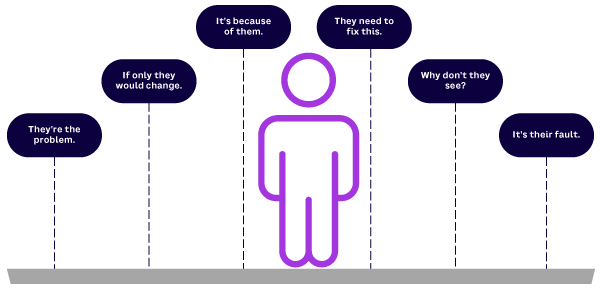
The exhaustion you feel isn’t from the pace of change. It’s from fighting projections you’re generating. Think about standing in a cage made entirely of your own repeated thoughts: “We’re not prepared.” ... “This is going to be like last time.” ... “We need a plan for everything.” You push against these bars, exhausting yourself building comprehensive frameworks.
Behind you, the door stands wide open (your capacity to see clearly and respond fluidly), but you can’t see it. You’re facing outward, focused on controlling imagined futures. The prison is made of your own projections (see Figure 1).
The Pattern You’ve Been Living
Consider what you’ve tried:
-
Scenario planning. You project imagined futures and try to prepare for each one. When reality differs (as it always does), your scenarios become useless.
-
Risk frameworks. You identify projected threats and build controls around them. When new risks emerge from unexpected directions, your controls become obstacles.
-
Business continuity plans. You prepare for past crises to repeat. When disruption takes a different form, your plans create rigidity instead of resilience.
You’re using past patterns to predict and control future disruptions. But real disruption rarely matches your projections. When it doesn’t, the entire framework collapses. Not because the framework was poorly designed, but because you cannot solve a projection problem with structural solutions.
Leadership expert Stephen Covey said, “Change — real change — comes from the inside out.”1 Rigid inner systems create brittle outer ones. You can attempt to design flexible structures, but if you’re still operating from projection, those structures will generate the same rigidity you’re trying to prevent.
What You’re Actually Defending Against
More than a decade ago, I attended a workshop with Joseph Jaworski, author of Synchronicity: The Inner Path of Leadership.2 He said, “If we could only see reality more as it is, it would become obvious what we need to do.” That statement haunted me. What did he mean by “see reality more as it is”? Weren’t we already seeing reality?
Years of inner work revealed the answer: we’re not seeing reality at all. We’re seeing our projections of it. Your mind decides what it wants to see based on beliefs, judgments, and past experiences. Then it arranges perception to confirm those projections. You’re not responding to actual conditions. You’re reacting to mental movies about what things mean based on the past.
When you think “We’re not ready for disruption,” that thought literally prevents you from seeing organizational adaptive capacity. The thought determines what can be perceived. The chaos you’re defending against? You’re generating it through your own thoughts, then reacting to that generation as if it were external reality.
In truth, we’re rarely defending against external chaos. We’re defending against our own misperception of it. The instant we recognize this, a new kind of intelligence becomes available. Awareness reinterprets the moment, showing us what’s actually present beyond judgment or assumption.
2 Ways of Meeting Reality
1. Projection-Based Planning
You react from fear of repeating past failures. You build scenarios based on projected futures rather than present conditions. You create comprehensive plans that become rigid when reality differs. You demand certainty and control over inherently uncertain situations.
This feels like constant mental rehearsal and a tightness in your chest during planning sessions. Your inner voice says, “We need to prepare for everything.” You experience frustration when people don’t follow the plan and exhaustion from trying to control what might happen.
This creates frameworks that shatter. Teams that become rigid. Innovation that dies because it doesn’t fit the plan. Adaptive capacity that atrophies from lack of use.
2. Perception-Based Responding
You perceive actual conditions without the fog of past-based projections. You respond fluidly to what’s here, not to mental movies about what it means. You adapt naturally and are comfortable with uncertainty because you’re not demanding that reality match projections.
In a turbulent period requiring rapid organizational change, one leadership team faced a choice. It could build comprehensive change management frameworks (projection) or develop capacity for team members to lead themselves through uncertainty (perception).
It chose perception. Rather than trying to manage the change, it created space for distributed leadership in every team member. Team members stopped waiting for direction and started responding to what they saw. Adaptability and resonance emerged naturally. What could have been organizational chaos became leadership based on reality at every level.
This feels like spaciousness in meetings, curiosity about what’s emerging, and physical relaxation even in crisis. Your inner voice is quiet, your responses emerge naturally, and you experience energy from meeting reality directly. This creates genuine resilience, teams that adapt fluidly, innovation that emerges naturally, and capacity that strengthens through use.
The Recognition That Changes Everything
Here’s where most leaders either get it or dismiss the whole thing: you are not the voice in your head generating those projections. You are the awareness that can observe it.
Most leaders spend their entire careers identified with the voice. They think they are the voice generating strategies, building frameworks, and projecting worst-case scenarios. But that voice isn’t you. It’s a tool. You are the awareness behind it.
Before this recognition: You live unconsciously identified with projected fears. A thought arises (”We’re not prepared”), and you immediately start building defenses. You can’t separate yourself from the thought. You think you are the thought.
After this recognition: A space opens. A thought arises (”We’re not prepared”), and you notice: “That’s projection. What’s actually here?” You can observe the voice without being controlled by it. The voice is still there, generating scenarios and warnings. But you’re no longer imprisoned by it. You can use it when needed and set it aside to perceive clearly.
This isn’t philosophy. This is the threshold that separates organizations that build real resilience from organizations that build elaborate tension.
The 3-Stage Shift That Creates Natural Resilience
Organizations don’t fail at resilience because frameworks fail. They fail because leaders unknowingly generate fragility through projection, then build elaborate defenses against their own thoughts. The solution isn’t better frameworks; it’s shifting from projection to perception, from reacting to mental movies to responding to actual conditions.
Making this shift doesn’t require years of meditation retreats or philosophy degrees. It happens the moment you move from one way of seeing to another. It means seeing disruption through the lens of past failures and imagined future threats to seeing what’s actually present and responding to real conditions as they emerge.
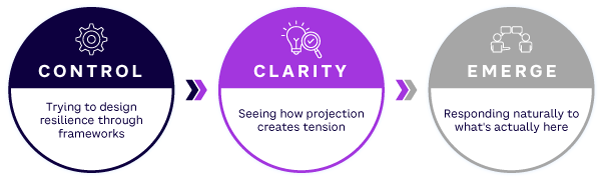
This shift happens in three recognizable stages (see Figure 2):
-
Control. You’re trying to design resilience through comprehensive frameworks, building elaborate structures to manage imagined futures and exhausting yourself by pushing against bars of your own making.
-
Clarity. You see how projection creates tension. You recognize that your frameworks aren’t solving the problem because you’re generating tension yourself through projected scenarios.
-
Emerge. You stop reacting to mental movies and start perceiving actual conditions. Adaptive capacity begins flowing naturally. You’re not building resilience; you’re removing the obstacles to resilience that are already present.
What Perception-Based Leadership Looks Like
Imagine that the new executive in 2009 had paused and asked: “Am I seeing this initiative clearly, or am I projecting my past experience onto it?”
From that pause, questions emerge:
-
What’s actually working here?
-
What capacity already exists that I’m not seeing?
-
How can I build on what’s proven rather than react to my fears?
With clearer perception, that executive would have seen:
-
A functioning system with measurable results
-
Teams with developed adaptive capacity
-
Specific elements worth keeping and specific gaps worth addressing
-
An opportunity to enhance rather than demolish
The adaptation would have been:
-
Evolutionary rather than revolutionary
-
Built on existing capacity rather than creating fragility
-
Based on actual conditions rather than projected fears
That’s the difference. Same organization. Same circumstances. Completely different outcomes.
Organizations that make this perceptual shift see three measurable changes:
-
Decision speed increases. Leaders spend less time building comprehensive scenario plans and more time responding fluidly to actual conditions. The question shifts from “Have we planned for every possibility?” to “What’s actually present, and what does it require?”
-
Adaptation becomes natural. Teams stop waiting for approval to respond and start acting on what they see. Without unnecessary projections, the appropriate response often becomes self-evident. Innovation replaces desperate “firefighting.”
-
Exhaustion decreases. The energy that was consumed fighting projections (defending against scenarios that exist only in imagination) gets redirected toward creating value. Leaders report feeling simultaneously more relaxed and more responsive.
3 Practices to Make the Shift
The shift from projection to perception doesn’t require meditation retreats or years of inner work. It requires something simpler and more challenging: the willingness to notice projection in real time.
Practice 1: The Question That Changes Everything
You’re in a crisis meeting. Market disruption just hit. Your COO is demanding immediate action. Everyone’s looking at you. Your mind is already generating the movie: “This is going to spiral. We’re not ready. We’ll lose market share.”
Stop.
Notice that voice. Notice that you’re generating a movie about what this disruption means. Ask yourself one question:
“Am I seeing the actual situation or my mental movie about it?”
That pause and simple question create space between stimulus and response. In that space, something shifts. The tightness in your chest loosens. Your mind stops racing through worst-case scenarios. You can see what’s in front of you: Your team has relevant experience. You have existing relationships with partners who’ve navigated similar disruptions. There’s adaptive capacity already present that you couldn’t see when you were trapped in projection.
The movie is still there, “We’re not ready.” But now you can observe it rather than be controlled by it. Each time you pause, you return to direct perception of actual conditions — not your story about them, not judgments from past crises. When you catch yourself reacting to a mental movie, you can choose to release it.
When you ask, ”Am I seeing the actual situation, or my interpretation of it?” you activate a higher form of perception. It’s the capacity to see things as they are, not as your conditioning predicts them to be. From that space, appropriate action arises naturally, without the tension of trying to control every variable.
This isn’t soft leadership. This is the mechanism that dissolves rigid patterns and reveals adaptive capacity.
Practice 2: Use Your Triggers as Teachers
You’re presenting quarterly results. A board member challenges your team’s response time. You feel your jaw tighten, and heat rises in your chest. The voice starts: “They don’t understand the constraints we’re under. They never appreciate what we accomplish.”
That thought isn’t about them. It’s revealing something in you. Maybe your own fear of not being good enough or a belief that you have to prove your worth. The quality of your response tells you everything:
-
Agitation, compulsion, need to be right → operating from projection
-
Clarity, creative energy, peace with outcome → operating from perception
Leaders who transform organizations use triggers as compass points toward their own growth, not as evidence that others need to change.
Practice 3: Build Perception Capacity into Culture
You’re reviewing the annual planning cycle. Your team presents the usual: comprehensive scenario plans, risk matrices, detailed continuity protocols. Instead of approving the plan, you ask, “Are we building capacity to perceive clearly and respond fluidly, or are we defending against projections?” The room goes quiet. Someone asks what you mean.
You respond, “Show me how this plan helps us notice when we’re reacting to mental movies versus responding to actual conditions. Show me how it strengthens adaptive capacity rather than plan compliance.”
Real resilience isn’t built in crisis. It’s built daily through developing perception capacity.
Stop:
-
Designing elaborate scenario plans (they’re projections)
-
Measuring plan adherence (it creates rigidity)
-
Demanding comprehensive frameworks (they defend against fantasies)
Start:
-
Cultivating capacity to perceive clearly and respond fluidly
-
Measuring adaptive response quality (not plan compliance)
-
Building cultures where projection is noticed and perception is practiced
Build it into leadership development. Practice it in every planning session. Model it in every crisis. Move from “How do we execute our crisis plan?” to “What’s actually happening, and what does it actually require?”
Quick Reference: The 3 Practices
-
Practice 1: The Pause. Ask yourself: “Am I seeing the actual situation, or my mental movie about it?”
-
Practice 2: The Trigger. Notice your physical response. Agitation = projection. Clarity = perception.
-
Practice 3: The Culture Question. Ask your team: “Are we building capacity to perceive clearly, or defending against projections?”
Your Organization’s Resilience Begins in Your Next Meeting
Resilience is available right now. The instant you notice projection and choose to see what’s present, that’s resilience. Not the idea of resilience. Not the plan for resilience. Actual resilience, happening in real time.
This isn’t a journey with stages you progress through. It’s a choice you make now, and now, and now again. That pause, repeated consistently, develops perception capacity. Over time, what once required conscious effort becomes natural. You begin to notice projection automatically. The space between stimulus and response widens. Response becomes fluid rather than rigid.
As Dee Hock, founder and CEO emeritus of Visa, said 40 years ago: “The inner path of leadership is the journey we all must take in the 21st century.”3 Not because it’s nice to have — but because you can’t build adaptive systems from a non-adaptive mental model. You can’t design fluid response capacity from rigid, projection-based thinking.
What This Means for You
Organizations invest millions in building resilience frameworks that shatter under real disruption. Meanwhile, the adaptive capacity they’re seeking is already present, obscured only by the projections they’re reacting to.
Your organization’s resilience doesn’t begin when you finish the next planning cycle. It begins the moment you stop projecting and start perceiving, when you stop reacting to mental movies and start responding to reality. Your next crisis meeting will reveal everything. Not because the disruption will be different but because you’ll see where you’re operating from. If you walk in and immediately start building scenarios, demanding comprehensive plans, and needing to control every variable, that’s projection. You’re reacting to mental movies.
If you walk in and find yourself curious about what’s emerging, comfortable with uncertainty, responding to what’s present, that’s perception. You’re seeing reality as it is. The frameworks you’ve built aren’t wrong; they’re just not the source of resilience. Resilience lives in that pause. In the space between stimulus and response. In your capacity to notice projection and choose to see what’s here instead.
That capacity is available right now. Not after you implement the framework. Not when everyone’s trained. What will you see in your next meeting — actual conditions or mental movies about them? That’s where your organization’s resilience begins.
At your next meeting, before you speak, enjoy your next breath and ask, “Am I seeing what's actually here or what I’m afraid might happen?” That pause is where your personal resilience begins.
References
1 Covey, Stephen R. The 7 Habits of Highly Effective People. Free Press, 1989.
2 Jaworski, Joseph. Synchronicity: The Inner Path of Leadership. Berrett-Koehler Publishers, 1998.
3 Jaworski (see 2).