
LCA (lifecycle assessment) is a comprehensive methodology that evaluates the environmental impact of a product, construction asset, or system across its lifecycle. This assessment spans every phase, from extraction of raw materials to manufacturing, transportation, construction, operation, and end-of-life disposal (or, preferably, recycling).
In the construction industry, LCA is critical for understanding the full scope of a project’s environmental implications. By analyzing the entire lifecycle, it identifies stages where the environmental impact is most significant, whether that’s energy-intensive material production, emissions generated during construction, or long-term energy use of an asset during its operational phase.
LCA allows construction companies to quantify environmental factors such as greenhouse gas emissions, energy consumption, water use, and waste generation across each project phase. This gives stakeholders a clear picture of the environmental footprint of a building or infrastructure project, helping them make informed decisions that minimize negative impacts. For instance, LCA might reveal that a particular type of concrete would result in higher emissions during production but lower energy consumption during an asset’s operational life, helping to balance short-term and long-term environmental impacts.
An integral part of LCA is environmental product declarations (EPDs), which provide standardized documentation on the environmental impact of individual building materials or products. EPDs offer transparent, verified data on the carbon footprint, energy use, and resource depletion associated with a product. These declarations are essential for accurately assessing the environmental impact of the materials used in construction. When integrated into LCA, EPDs help construction companies make informed comparisons between materials and products so they can choose the ones with the least environmental impact.
Opportunities for Integrating Digital Innovation & LCA
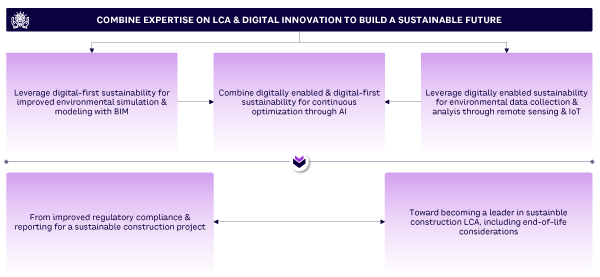
Digital innovations can enhance LCA practices in several ways (see Figure 1):
-
Leverage digital-first sustainability for improved environmental simulation and modeling. Building information management (BIM) is a powerful tool that creates detailed digital designs of buildings, enabling a digital-first approach in which various design scenarios and optimizations can be simulated at marginal cost. This lets architects and engineers assess the environmental impacts of design choices before physical work begins. For example, BIM can model the energy performance of various window types, wall materials, or HVAC systems, helping project teams select options that reduce energy consumption and carbon emissions. It can also simulate how much the use of recycled or low-impact materials would lower the overall environmental footprint of the building.
-
Leverage digitally enabled sustainability for environmental data collection and analysis. Drones, remote sensing, and Internet of Things (IoT) bring a new level of precision to LCA by enabling continuous monitoring of an asset’s physical state. For example, drones and laser scanners help companies identify issues with insulation during construction. IoT sensors can be embedded in structures to track real-time data on energy consumption, water use, material wear, and environmental conditions such as temperature and humidity. This data collection is invaluable for LCA, enabling assessments based on operational performance rather than theoretical models or estimates. For instance, by monitoring energy use at different times of day and/or seasons, IoT devices reveal how building systems perform under varying conditions, leading to more accurate and dynamic LCA outcomes.
-
Combine digitally enabled and digital-first sustainability for continuous optimization. AI plays a crucial role in analyzing the vast amounts of data generated by BIM, drones, remote sensors, and IoT devices. AI algorithms can identify patterns and trends that might not be immediately apparent and suggest optimizations that can significantly reduce environmental impacts. For example, AI can analyze LCA data to recommend alternative construction methods that use less material or generate less waste. Similarly, physical processes such as material transportation can be optimized, reducing fuel consumption and emissions. Finally, AI can help with predictive maintenance, identifying when equipment is likely to fail and suggesting repairs before breakdowns occur, minimizing downtime.
-
Improve regulatory compliance and reporting for more sustainable construction. As sustainability regulations become stricter, LCA is the key to helping construction companies ensure compliance with stricter environmental laws and standards. BIM, IoT, and AI can automate environmental-impact tracking and reporting, making it easier to meet regulatory requirements and demonstrate sustainability credentials to stakeholders. This is particularly important for projects seeking certifications such as BREEAM (Building Research Establishment Environmental Assessment Method) or DGNB (German Sustainable Building Council), where detailed environmental reporting is mandatory.
-
Understand end-of-life considerations. LCA does not stop at the construction or operational phases of an asset. It includes the end-of-life stage, which encompasses demolition, recycling, or repurposing of asset materials. Digital tools can assist in planning for an asset’s end of life at the design stage. BIM can be used to design assets that are more easily deconstructed, allowing materials to be recycled or reused. AI optimizes this process by analyzing the best ways to disassemble structures to recover the maximum amount of reusable material, reducing the need for new resources and lowering environmental impact.
[For more from the authors on this topic, see: “Building a Sustainable Future in Construction: Integrating Digital Innovations & Lifecycle Assessment.”]