


Strategic advice to leverage new technologies
Technology is at the heart of nearly every enterprise, enabling new business models and strategies, and serving as the catalyst to industry convergence. Leveraging the right technology can improve business outcomes, providing intelligence and insights that help you make more informed and accurate decisions. From finding patterns in data through data science, to curating relevant insights with data analytics, to the predictive abilities and innumerable applications of AI, to solving challenging business problems with ML, NLP, and knowledge graphs, technology has brought decision-making to a more intelligent level. Keep pace with the technology trends, opportunities, applications, and real-world use cases that will move your organization closer to its transformation and business goals.
Insight



"Context over content" is a good metaphor to keep in mind when considering a technical debt assessment, reduction, and prevention engagement. Specific patterns in your code and the intricacies of your programming environment are paramount factors in determining how general insights will be turned into actions. In other words, it is unlikely that a technical debt engagement in your company will evolve along similar lines to those taking place in your competitor's "shop" down the street.




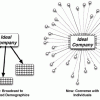

The rise of pervasive connectivity and social media certainly means more opportunities to look bad -- but also more opportunities to learn and look good. In this changing environment, companies that make the commitment to be a learning organization, become truly curious about their customer experience, and take on continuous improvement will be the ones that take the best advantage of "the Connected Age." In this Executive Report, we will explore what has changed about collecting customer research since the rise of the cloud and what these changes mean. We'll enumerate the many ways you can learn more than ever before about your company, your products and services, and your customers -- and how they interact.
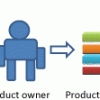
Building products that customers love is the mantra for this century. As such, there are no defined processes or methods that provide a magic formula for achieving this. Building innovative products still requires creative people with good leaders driving the process. Even the most popular method embraced in the IT industry -- Scrum -- does not provide the needed support.
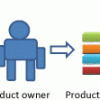
Building products that customers love is the mantra for this century. As such, there are no defined processes or methods that provide a magic formula for achieving this. Building innovative products still requires creative people with good leaders driving the process. Even the most popular method embraced in the IT industry -- Scrum -- does not provide the needed support.