


Strategic advice to leverage new technologies
Technology is at the heart of nearly every enterprise, enabling new business models and strategies, and serving as the catalyst to industry convergence. Leveraging the right technology can improve business outcomes, providing intelligence and insights that help you make more informed and accurate decisions. From finding patterns in data through data science, to curating relevant insights with data analytics, to the predictive abilities and innumerable applications of AI, to solving challenging business problems with ML, NLP, and knowledge graphs, technology has brought decision-making to a more intelligent level. Keep pace with the technology trends, opportunities, applications, and real-world use cases that will move your organization closer to its transformation and business goals.
Insight

Good architects also need to be good "marketects": they must be able to sell and promote their cause as well as publicize their achievements, outcomes, and results. But how do they do this? What tips and guidelines from the world of marketing can architects adopt to their advantage?
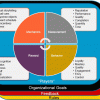
Everything in life is a game. Someone is always keeping score. Everyone is being measured, whether we like it or not. Gamification, a technique that all business leaders need to become familiar with, takes advantage of this fact.


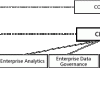

Many, many years after enterprise resource planning and over two decades into data warehousing, many business executives are still frustrated over their inability to trust their company's data. They have spent millions on new technologies, only to find that the state of their data assets has deteriorated. This significantly reduces the business value of their investments. One big reason for this continuing data chaos is that companies do not manage their data as a business asset, and there is no one watching the store. In this Executive Report, we look at the role of chief data officer and why this role is so important. Not a Cutter client yet? Download a free copy of the report now.
Let's be clear: data is a critical asset along the same lines as inventory, cash, buildings, personnel, and accounts receivable. Without good data, we are unable to make the correct operational, tactical, and strategic decisions that are the difference between those organizations that live and those that die. Yet there are very few organizations that have stepped up and established the role of a chief data officer (CDO) with the responsibility and authority to deal with the many complex and interrelated issues, both political and technical, that swirl around data. In the accompanying Executive Report, we look at this role and its responsibilities.

"Today, social, mobile, analytics, and cloud are the cornerstone technologies driving innovation inside many if not most enterprises."
-- Vince Kellen, Guest Editor
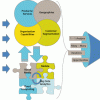

Implementation of social media crowdsourcing helped Starbucks understand customer preferences and generate new ideas that resulted in US $180 million in revenue in the first year, making a big impact on the top line.1
Amazon reported that 30% of sales were due to its analytics-based recommendation engine.2
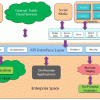
The world is going through a massive digitalization in the consumer ecosystem due to the influence of social, mobile, analytics, and cloud (SMAC). The evolution of SMAC throws integration challenges in front of enterprises, forcing them to handle various SMAC endpoints in the simplest way.