



Strategic advice to leverage new technologies
Technology is at the heart of nearly every enterprise, enabling new business models and strategies, and serving as the catalyst to industry convergence. Leveraging the right technology can improve business outcomes, providing intelligence and insights that help you make more informed and accurate decisions. From finding patterns in data through data science, to curating relevant insights with data analytics, to the predictive abilities and innumerable applications of AI, to solving challenging business problems with ML, NLP, and knowledge graphs, technology has brought decision-making to a more intelligent level. Keep pace with the technology trends, opportunities, applications, and real-world use cases that will move your organization closer to its transformation and business goals.
Insight

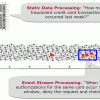
This CBR issue is motivated by the following trend: the ability to access and analyze data as it's created in real (or near real) time. This issue's articles work particularly well together. Federico and Elisabetta help draw our attention to the higher-level question of value creation; a question every organization must tackle. After all, real-time data analytics is difficult and expensive and organizations need to know that they will earn a return on their investment. Zubin then grounds us with some excellent advice and insight around implementing and managing real-time data analytics. Regardless of where you are along the real-time data analytics path, I trust both the survey data and articles in this issue will serve you well.

The ubiquitous, massive creation of real-time data in a natively digital form (a phenomenon known as "digital data genesis,"1 or DDG) provides unprecedented opportunities for novel value creation. Pulled by the diffusion of sensors -- and the consequential increase in the creation, storage, communication, and processing of information -- such generated data can be made readily available or streamed to other partners or appropriately transformed in customer value-added services. We define this concept as the "digital data stream," or DDS. We believe the organizational implications of both DDG and DDS are enormous but that much is still to be understood in order to profit from the harvesting and streaming of data sources. What form does value creation take today? Which activities enable these new forms of value creation? How do these new possibilities for action become tangible value propositions?
-
First stop: 30,000 feet. For me, one of the key messages from this issue has been the clear need for big-picture thinking.

SURVEY DEMOGRAPHICS
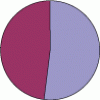
This survey examined how organizations approach real-time data; how they might use real-time data to benefit the organization; the challenges and barriers to the exploitation of real-time data; real-time data analytics; and the sources, type, and frequency of real-time data streams. A bit more than half (57%) of the 54 responding organizations are headquartered or based in North America, with 19% in Europe, 15% in Asia, 6% in Australia/Pacific, and 2% each in the Middle East and South America.


In my last Advisor (“ Big Data Analytics in a Socially Infused Healthcare Enterprise”), I shared an account of leveraging Big Data analytics in a large healthcare IT organization.


A process, in my honest opinion, is the product of its era. It reflects the needs, the constraints, and the predicaments of its time. As those change, the process needs to evolve in tandem. If it does not, it is likely to become obsolete.