



Business Transformation Requires Transformational Leaders
Leadership and teaming skills are front and center in times of rapid change. Meet today’s constant disruption head on with expert guidance in leadership, business strategy, transformation, and innovation. Whether the disruption du jour is a digitally-driven upending of traditional business models, the pandemic-driven end to business as usual, or the change-driven challenge of staffing that meets your transformation plans — you’ll be prepared with cutting edge techniques and expert knowledge that enable strategic leadership.
Subscribe to Arthur D. Little's Culture & Leadership Newsletter
Insight


Thanks to some initial findings from a recent Cutter survey, we now have a better understanding of the extent that organizations are actually implementing (or planning to implement) enterprise app stores.


Cyber warfare has been in the news more and more and, increasingly, this news has dealt with the murky world of Internet/computer security attacks by nation states and other quasi-official groups. Over the last couple of years we've seen ominous terms showing up in a number of major developments widely reported in the media.




The realm of Big Data is described by volume, velocity, and variety. Volume and variety have frequently been discussed, centering upon support for Hadoop and MapReduce. Volume, of course, refers to the sheer size of data sets, and variety is mainly about the increasing need to analyze unstructured data.


In the first Advisor in this series ("What's a Knowledge Worker to Do? Part I"), I pointed out that knowledge worker jobs are increasingly being replaced due to the rise of Big Data analytics and significant improvements in high-performance computing.
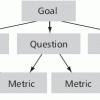

This Executive Update presents a methodology and a set of tools designed to support the software development process based on the collection and analysis of a large set of information. The design of such a system faces several challenges, such as data reliability and generating useful and timely analysis for both developers and managers. Furthermore, the data and its related analysis are not enough to support the development process in an effective way.


In this recorded, on-demand webinar, Cutter Fellow Robert D. Austin will inspire you to take a break from the way you typically view product development to consider techniques borrowed from the arts.