

Strategic advice to leverage new technologies
Technology is at the heart of nearly every enterprise, enabling new business models and strategies, and serving as the catalyst to industry convergence. Leveraging the right technology can improve business outcomes, providing intelligence and insights that help you make more informed and accurate decisions. From finding patterns in data through data science, to curating relevant insights with data analytics, to the predictive abilities and innumerable applications of AI, to solving challenging business problems with ML, NLP, and knowledge graphs, technology has brought decision-making to a more intelligent level. Keep pace with the technology trends, opportunities, applications, and real-world use cases that will move your organization closer to its transformation and business goals.
Insight
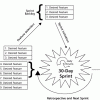

Agile development methodologies represent an ongoing challenge for developers, as they impose processes and requirements that are at odds with traditional waterfall methodologies and do not map well to conventional lifecycle models. While new methodologies naturally create a need for process change, it is important to understand that lifecycle processes have been established to support a range of requirements beyond the needs of development itself.
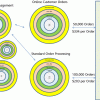
Executive Update
IT: Finding Common Ground with Your Customers
There's a fundamental problem between the IT profession and its customers: there's an abundance of focus on the cost of the technology (the "T"), yet a dearth of focus on the value of the information (the "I") side of the equation. If the connection between I and T is not clear, then the cost of the technology becomes the only common ground between IT and its customers, and this ground is business quicksand.


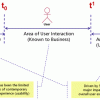

The accompanying Executive Report presents a user experience analysis framework (UXAF) as an all-encompassing view of a user's experience with a business that transcends the "known" areas of usability and usage-centered designs of software systems.