



Strategic advice to leverage new technologies
Technology is at the heart of nearly every enterprise, enabling new business models and strategies, and serving as the catalyst to industry convergence. Leveraging the right technology can improve business outcomes, providing intelligence and insights that help you make more informed and accurate decisions. From finding patterns in data through data science, to curating relevant insights with data analytics, to the predictive abilities and innumerable applications of AI, to solving challenging business problems with ML, NLP, and knowledge graphs, technology has brought decision-making to a more intelligent level. Keep pace with the technology trends, opportunities, applications, and real-world use cases that will move your organization closer to its transformation and business goals.
Insight
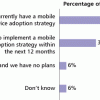

In October and November 2012, Cutter Consortium conducted a survey that asked 69 end-user organizations worldwide about their use of mobile devices, including smartphones and tablets, in order to provide their employees and partners with the ability to interact with business operations, ranging from basic email to CRM and BI while "on the go." Our goal was to

"Enterprise patterns are now an established approach that can be used to describe and explain architectural change at all levels -- from IT transformation to product lifecycle management, from business capability architecture to real-time enterprise frameworks."
-- Roger Evernden, Guest Editor
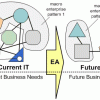
By employing patterns, organizations can leverage prior experience to deal with existing and future problems. This can save time and money and reduce risk.
Incorporating changes in our individual lifestyle is difficult, whether it be learning new skills or changing our habits. Incorporating meaningful change in large enterprises with several individuals is exponentially more difficult.
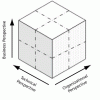
When Robert Solow first said, in 1987, that "you can see the computer age everywhere but in the productivity statistics,"1 it highlighted a perennial problem: the disconnect between the investments made in IT and actual business benefits.
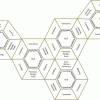

Uncertainty or unpredictable change affecting the enterprise is inevitable. Business executives struggle to respond to change and at the same time maintain alignment between strategy and organizational structure for firm performance. A business capability architecture (BCA) is an overarching enterprise pattern that delivers business outcomes by binding every enterprise change to a business strategy.
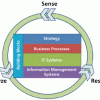

Successful organizations have a dilemma. Should they continue growing what is making them successful, or should they disrupt the market that they are successfully leading? What if they choose to grow their current business and later get disrupted by an upstart innovation? Or what if they disrupt a successful business too early? What if they overestimate the potential of an external disruption?