

The structure of the IT organization is an important factor in supporting a company's ability to respond to market forces and compete effectively. Clearly, IT should be organized in a way that will deliver the most value to the firm, but choosing an organizational structure is not easy. Next month, we'll examine the different organizational choices for IT so that you can determine which one will work best for your company. Is your primary strategic objective profit? Asset utilization? Growth? Find out which IT organizational structure best fits each of these strategic directions. Learn how pairing business product teams with their own dedicated IT units can produce high-output team velocity combined with ever-growing domain knowledge and experience. Finally, discover how adopting a sports team's approach to recruiting, specialized positions, coaching, and retention can turn your IT organization into a winning franchise.
Organizations across industries adopt different business strategies, warranting different IT strategies. Fundamental to these IT strategies are the ways in which organizations design their structures. While it is obvious that "one structure does not fit all," the larger question we need to ask ourselves is: "Is there even one right structure for a particular IT organization?"
In this article, we will explore the factors that affect organizational structures both in terms of business imperatives and IT functions and offer some guidance on creating the "right" structure.
WHAT AFFECTS THE STRUCTURES?
Organizational structures are affected primarily by the business imperatives that define the strategic performance of a firm and the IT functions that are needed to reinforce these business imperatives.
BUSINESS IMPERATIVES
Organizations typically focus on the following three business imperatives for strategic performance:
1. Profit
2. Growth
3. Asset utilization
IT FUNCTIONS
The approach to IT organization arrangement may vary depending on the roles of various IT functions across the following three layers:
1. Strategy -- functions to provide direction to the IT organization
2. Management -- functions to address the strategic objectives
3. Operations -- functions to support the operational elements of the IT organization
Factors such as market dynamics, industry trends, customer needs, competitor moves, and organizational culture, as well as internal strategic directions like organizational growth, geographic spread, and process orientation, also affect organizational structures. However, rather than rushing to visualize the myriad of plausible arrangements suggested by these secondary factors, we should first explore how each of the primary factors (i.e., business imperatives and IT functions) affects organizational structures.
HOW DO BUSINESS IMPERATIVES AFFECT IT ORGANIZATION STRUCTURE?
Each business imperative has a bearing on the strategic performance, as defined by a set of measures (e.g., ROI, revenue growth). Maximizing these measures would require firms to address structures in addition to a host of other strategic drivers, such as capitalizing on regulatory changes, acquiring innovations in products/technology, and strengthening brand image.
PROFIT
The primary objectives of a profit-oriented firm are to reduce cost and/or increase productivity. The IT organization in such firms focuses on:
- Institutionalizing business participation in IT decision making
- Tracking IT's business value by measuring IT investments
- Clearly allocating IT costs to business units (BUs)
Structurally, these goals would necessitate the following organizational changes:
- Creating an IT organization designed to support central IT control and standardization, particularly for infrastructure and architecture
- Instilling a capital approval mechanism by considering IT as another business investment and using different approaches for different IT investment types
- Using governance mechanisms such as a formal budgeting process to prioritize, allocate, and manage resources across the firm
Therefore, the key drivers for lower business costs and better return on investment/equity are a high degree of standardization and efficiency of IT operations. To achieve these key drivers, profit-oriented firms tend to have centralized IT structures. They may, for instance, have executive committees for decision making and centralized processes for architecture compliance, IT investment decision making, and the like.
Case in Context
In the late 1980s, a large financial company in the Asia Pacific region started a Regional Card Center (RCC) as a shared service to support its startup credit card business in this region. The shared service was predominantly focused on providing consolidation of data-processing operations. Initially, it was difficult to acquire the buy-in from all the various country managers, as this shared service had a direct impact on their operating performance. But it was seen that, due to centralization, the cost of processing the cards came down to one-third the cost it was three years back. Soon this service was extended across the globe, and the costs of cards came down even further. With the success of this centralized service, the RCC started rendering various other services, such as production support, software design for new products, acceptance testing, and ensuring adherence to ever-changing compliance rules.
GROWTH
In the case of growth-driven firms, the primary objective is to reduce time-to-market cycles and expand existing as well as new businesses. The IT organization in such firms focuses on:
- Innovation at the BU level
- Local accountability for quick responsiveness and agility
- Coordination with IT at the corporate level for propagation of policies/processes
Structurally, these objectives would necessitate the following organizational considerations:
- Empowering IT organizations at the BU level to drive IT investments and innovation with communities of practice, then integrating these communities of practice at the organization level at a later point of time
- Providing a thin, enterprise-wide IT infrastructure capability where each independent unit is not only allowed but also encouraged to have its own, independent infrastructure
- Placing IT professionals into operational units focused on meeting the needs of internal and external customers
Thus, we observe that, to achieve the business objective of growth, firms need to design their organizational structure in a modular fashion. They must focus on business unit innovation, coordination of learning, and high responsiveness to market changes. In contrast to profit-oriented firms, there will be limited enterprise-wide standardization; a decentralized structure is best suited for growth-oriented firms.
Case in Context
A US-based business-to-business car auctions company launched an independent online business unit to grow its online business and reinforce its industry-dominant position. Like most high-growth startups, the firm did not tightly integrate its architecture or infrastructure capabilities, focusing instead on managing projects for rapid development. The development teams were responsible for all aspects of deploying a new online service: product management, deployment of Web servers, and development and quality assurance of the service. This decentralized approach to IT organization structure allowed the firm to address its current business imperatives of innovation and growth of its business base.
As the firm grew in size, it identified a need for greater attention to a more centralized architecture and reusable infrastructure services. Today, the online business is integrated into the overall business model, relying on a set of shared IT services. Accordingly, IT organization structure has transitioned to a blend of centralized and decentralized arrangements.
ASSET UTILIZATION
Resource sharing and optimal utilization are the primary objectives for organizations whose business imperative is asset utilization. The IT organization in such firms focuses on:
- Setting IT principles via collaboration of CxOs and the IT group to balance business needs with basic IT objectives of sharing and reuse
- Specifying and measuring IT service and recouping IT costs from business
- Regularly reviewing processes within the IT group, looking for synergies, reuse opportunities, and trends across operational units
Structurally, these objectives would necessitate the following organizational considerations:
- Appointing business/IT relationship managers to focus on achieving business value from IT for their business units and leveraging enterprise-wide infrastructure
- Constituting process teams with IT members to help develop both process leadership and the IT infrastructure to enable enterprise system implementations and cross-functional business processes
- Instituting service-level agreements (SLAs) and chargeback mechanisms to help BU leaders see the value of shared services and make effective decisions on IT use
To achieve the business objective of a better return on assets (ROA) and reduced per-unit costs, the emphasis should be on efficiency and reliability. Asset utilization therefore demands a hybrid approach to the organization structure. A centralized authority with a high degree of process orientation (a characteristic of profit-oriented firms) and autonomy at the BU level (a characteristic of growth-oriented firms) demonstrate the hybrid nature of asset utilization structures. To be more specific, firms attempt to strike a balance between structures for profitability and structures for revenue growth and innovation. This orientation enables firms to achieve a combination of BU-driven customer responsiveness and economies of scale and standardization.
Case in Context
A privately owned conglomerate, largely grown through acquisition, wanted to focus on collaboration among the operating groups. With this business imperative, the CIO defined two IT principles:
1. Continuation of application development with the operating groups
2. Sharing of IT infrastructure
Translating these two basic principles into action led to the formation of specific bodies:
- Separate technology architecture committees to meet individual business needs
- An enterprise architecture (EA) organization comprising a team of business-unit IT representatives charged with establishing corporation-wide standards
- An IT council made up of business-unit CIOs and CTOs who discuss leveraging new technologies
- A shared services board to provide shared IT and financial services
By establishing a hybrid structure, this conglomerate was able to maximize opportunities to leverage shared services while minimizing constraints on the related, but distinct, needs of diverse business units.
As we can see, depending upon their particular business imperatives, organizations have different strategic drivers, metrics for measuring performance, IT mechanisms, and IT standards. All these lead to having a different IT organization structured for each of the business imperatives. The various factors and their nuances [1] have been captured in Figure 1.
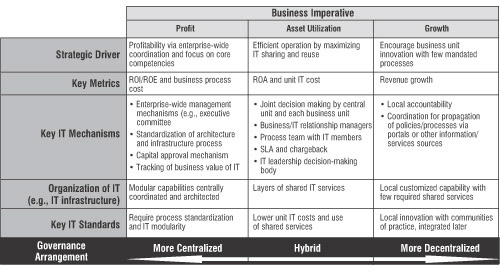
Figure 1 -- Comparison chart of organizations with different business imperatives. (Source: MIT Center for Information Systems Research [CISR].)
HOW DO IT FUNCTIONS AFFECT IT ORGANIZATION STRUCTURE?
IT functions represent the various activities performed across the three IT organizational layers: strategy, management, and operations. Figure 2 depicts the arrangement of various IT functions across these layers. Each of the layers has its own role to play in the entire lifecycle of IT operations. Thus, the functions under them have their own uniqueness, work characteristics, and a distinct influence on the business imperatives and also the IT structure.
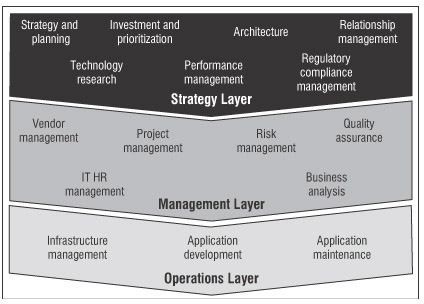
Figure 2 -- Placement of IT functions across the strategy, management, and operations layers.
STRATEGY LAYER
IT functions in the strategy layer provide direction to the functioning of IT. Functions in the strategy layer focus on:
- Reducing IT costs through overall process efficiency
- Providing a platform for scalability and flexibility
- Building an interface with external and internal partners
- Exploring innovative use of IT aimed at achieving business breakthroughs
Structurally, these goals necessitate the following organizational changes:
- Instituting a governance/approval process for enterprise- and BU-specific projects
- Forming a central body to drive agreements (with the concurrence of key stakeholders) on standards for the development of services/tools/projects
- Forming a corporate body to track regulatory changes and technology advancements
Thus, the strategy layer determines a direction for IT that is consistent with the business direction. This in turn enables the functions in this layer to support growth and encourage innovation.
Examples of Functions in the Strategy Layer
Organization of the architecture function. The enterprise architecture body needs to manage the EA framework and standards with the good of the enterprise in mind, as at times individual business units may feel a need to invest in tools and architecture contrary to the firm's best interests. At the same time, the central architecture team (responsible for reaching agreement on standards and services/tools) must sell the business case for architecture, ascertain risk measures for exceptions, establish processes for keeping the enterprise architecture up to date, and provide consulting services for business units and other projects. Given these responsibilities, the architecture function may need to be arranged in a centralized manner.
Structure for IT strategy and planning. The IT planning department carries out the primary functions of managing the steering committee approval process for enterprise and BU-specific projects. (The steering committee consists of, among others, the key stakeholders from the planning department.) It also takes care of steering the projects through the initiation process and determining the impact of these projects on current IT plans. At the same time, it takes inputs from the business objectives and corporate business plan and directs the IT organization with ideas, initiatives, and system maintenance for different business units. All this requires the institution of the IT planning department at the corporate level, as it becomes imperative to have a centralized structure for planning and strategy.
The functions in the strategy layer are critical and need to be arranged at an enterprise level reporting directly to the CIO, thus maintaining their independence.
MANAGEMENT LAYER
IT functions in the management layer are instrumental in providing necessary support for the smooth running of IT. Functions in the management layer focus on:
- Managing relationships between IT and business groups
- Understanding and addressing business needs in IT projects
- Managing cross-functional initiatives
The essence of the functioning of this layer is to understand business operations and support the strategic direction of the organization through formation of alliances between IT and business.
Structurally, these goals would necessitate the following organizational changes:
- Placing similar functions at both the corporate and BU levels, with varying degrees of responsibility. This becomes imperative for functions such as vendor management, especially for large IT organizations.
- Locating functions that require business knowledge at the BU level. For example, functions that require extensive knowledge of business processes, such as business analysis, make poor candidates for shared services and should be closely linked to the operations of respective business units.
- Placing functions that address cross-functional activities at the corporate level.
Examples of Functions in the Management Layer
Corporate vendor management. The corporate vendor management function involves identifying global vendors, negotiating master contracts, and managing vendors for major services or enterprise applications. A similar function could also exist at the BU level for local purchases, following established corporate guidelines.
Corporate PMO. A project management office drives enterprise consistency for implementation of cross-functional initiatives across business units. Such functions, therefore, should be owned at the corporate level.
The arrangement of the functions in the management layer will vary according to the objectives they intend to achieve and their work characteristics. Thus, we see that while functions such as a PMO are centralized, quality assurance -- while being centralized from the management perspective -- may be matrixed out to specific business units in order for the QA staff to develop subject matter expertise.
OPERATIONS LAYER
IT functions in the operations layer pertain to the day-to-day functioning of IT. Functions in the operations layer focus on:
- Identifying options for reducing redundancy
- Segregating functions based on their applicability
Structurally, these objectives would necessitate the following organizational changes:
- Combining functions depending on common processes and methodologies. This can be organized into shared services across business units, resulting in greater speed, quality, and consistency by imposing standards, better tools, and more effective methodologies.
- Compartmentalizing functions based on shared services or with a focus on business units. This would give rise to a blended model, balancing centralized efficiencies with BU responsiveness and control.
Examples of Functions in the Operations Layer
Combining development and maintenance functions. Common processes, such as change management in application development and application maintenance, can be combined as one function under one manager.
Compartmentalizing of functions. The application development function is one in which some specialized skills such as code generation can be centrally managed, while testing of the generated code can happen in a decentralized manner at the BU level.
The arrangement of functions in the operations layer will vary according to their scope and application.
WHAT IS THE RIGHT STRUCTURE?
What we have seen so far is how each of the individual factors affects the IT organization structure. While these insights are important, it is equally critical to view them together (see Figure 3). The rationale for doing so is to weigh the preferred structure for each of the business imperatives against each of the IT functions to determine available options and possible variations.
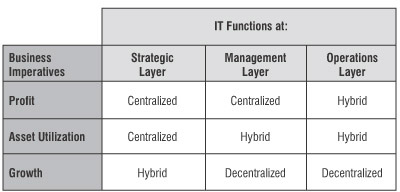
Figure 3 — Optimal organization structures according to business imperatives and IT functions.
Organizations whose business imperative is profit need to have a centralized IT organization structure for its IT functions at the strategic, management, and operations layers. Some firms can permit a slight variation at the operations layer, using a hybrid structure for flexibility reasons.
Organizations whose business imperative is growth can have a decentralized IT organization structure across the three layers. However, they can use a variant of the hybrid structure at the strategic layer for better insight into IT management.
Organizations whose business imperative is asset utilization need to have a hybrid IT organization structure for their strategic, management, and operational layers. The strategic layer here can be somewhat more centralized for better control and accountability.
IN CONCLUSION
The "right" structure is created when organizations follow the strategic sequence of prioritizing business imperatives, defining a set of IT functions aligned to the business imperatives, and evaluating variants at the strategic, management, and operational layers. Collectively, these steps can ensure superior strategic performance.
Creating and sustaining the right organizational structure for IT requires organizations to consciously and continuously monitor the primary factors (i.e., business imperatives and IT functions) and the secondary factors mentioned earlier (e.g., market dynamics, organizational culture and growth). To achieve the kind of course corrections required because of all these factors, organizations need to be agile and periodically revisit their organizational structures following the same strategic sequence.
REFERENCE
1. Weill, Peter, and Jeanne Ross. IT Governance: How Top Performers Manage IT Decision Rights for Superior Results. Harvard Business School Press, 2004.
ABOUT THE AUTHORS
Mohan Kancharla is a Senior Consultant in the Global Consulting Practice of Tata Consultancy Services (TCS) Ltd, focusing on IT strategy and governance consulting. Mr. Kancharla holds a bachelor's degree in computer engineering and a master's degree in business administration and has over 18 years of consulting, practice building, business development, solution architecting, and delivery experience. His broad industry expertise covers the banking and financial services, insurance, telecom, manufacturing, retail, utilities, media and entertainment, and pharmaceutical industries. Mr. Kancharla's achievements span across the consulting spectrum: strategy, business, IT, architecture, quality, and operational consulting.
As a Lead Consultant, Mr. Kancharla has successfully directed multiple consulting engagements for Fortune 500 companies worldwide. He was formerly Head of Euro Practice for TCS, based in London, with geographic responsibility for Europe. During this period, he was a prominent speaker on the European conference circuit. Prior to assuming this role, he was responsible for solution architecting and delivery of large projects for multiple technologies across the systems development lifecycle. Mr. Kancharla can be reached at Tata Consultancy Services Ltd, Tidel Park, 4 Canal Bank Road, Taramani, Chennai 600 113, India. Tel: +91 44 66163901; E-mail: mohan.kancharla@tcs.com.
Vipin Arora is Global Head of IT Strategy & Governance within the Global Consulting Practice of TCS Ltd. Mr. Arora has over 15 years of experience as a consultant, manager, analyst, and several other roles in the areas of IT consulting, global account management, large program management, quality processes, and customer value creation. He has been instrumental in growing TCS through establishing and bringing new business for the company during his stint as Regional Manager in the UK. Currently, his prime focus is in the field of IT strategy and governance, and he has been acknowledged by MIT for his contribution in this space. He has delivered several lectures on IT strategy and governance in many business schools and forums. Mr. Arora can be reached at Tata Consultancy Services Ltd, Plot No. 447, Phase 5, Sector 19, Udyog Vihar, Gurgaon 122016, India. Tel: +91 124 4164513; E-mail: vipin.arora@tcs.com.