Business Transformation Requires Transformational Leaders
Leadership and teaming skills are front and center in times of rapid change. Meet today’s constant disruption head on with expert guidance in leadership, business strategy, transformation, and innovation. Whether the disruption du jour is a digitally-driven upending of traditional business models, the pandemic-driven end to business as usual, or the change-driven challenge of staffing that meets your transformation plans — you’ll be prepared with cutting edge techniques and expert knowledge that enable strategic leadership.
Subscribe to Arthur D. Little's Culture & Leadership Newsletter
Insight
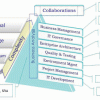
Organizations, especially large and global ones, are inundated with methods for everything. There are methods, processes, standards, frameworks, guidelines, and policies that apply in development, quality, governance, project management, and architecture — at varying levels in an organization. These methods and their variances are “owned” by roles.
Executive Update
The Power of Thank You
When you first started to talk, after "Dada," "Mama," "cat," and "dog," your parents probably taught you the importance of saying, "please" and "thank you." For most toddlers, "please" comes fairly easily. When you say "please" you're more likely to get what you want. The cause and effect is immediate. But "thank you" -- as I'll explain in this Executive Update -- is another story. "Thank you" is about goodwill -- and the future.



Advisor
Gamification in the Enterprise
Everything in life is a game. Someone is always keeping score. We're all being measured, whether we like it or not. Gamification is a technique that business leaders need to become familiar with in order to take advantage of this fact, since it takes measurement, behavior analysis, and engagement into the business setting in ways that can enable organizations to meet their objectives.